The target audience is one of the most important elements to a film. Get it right and it will be a massive success. Market to the wrong audience, however, and the film will make very little money. Certain genre's cater more obviously to target audiences, for instance a female audience is more likely to watch Rom-Com's than a male audience, while more men watch more action films than women.
Thriller films are different. While many genres are easy to cater for, different sub-genre's within the thriller genre are targeted at different ages and genres. Many thrillers are rated at a 16-25 age range while others are aimed at an older audience. It is less the gender than the cultural capital and education levels which also dictate the Target Audience of a thriller. For instance, the middle class or better educated are more likely to watch films with complex stories, like Thrillers.
The classification of films can help determine the target audience in terms of Thrillers. Se7en, an 18, is aimed at a more mature audience while the 12 rated Inception and 15 rated Donnie Darko are aimed at older teenagers/young adults. The content in the film also allows gives an idea of this. Films with lots of violence are often aimed at men, such as Se7en, while adaptations of books, are aimed at fans of the book. Classics in this case, may be aiming for new audiences, such as the recent Sherlock Holmes films, while others are catering to their source materials target audience, the Girl With The Dragon Tattoo containing a lot of the books content, thus getting it rated as an 18 in the UK, in keeping with its adult themes
However, some studios pride themselves on multiple target audiences. Pixar, for instance, appears to be aimed at a younger audience, but will contain themes and jokes for adults as well, catering to all ages. This is extremely difficult to do, however, and if you miss both target audiences, then your film cannot be a success.
I feel that from looking at similar films at other stages, my target audience would be male's between 18 and 24, and would likely be rated at either a 12 or 15 by the BBFC. This is because this market makes up most 'cinema-goer's' and many existing thrillers aimed at this age are rated 12 or 15 (Inception, Memento, the Dark Knight) with only a few, more action orientated thrillers getting 18's (Die Hard, Aliens, Taken). A full Audience Profile can be found here
Monday, 12 December 2011

Sunday, 11 December 2011
Linking Texts: Real Examples of films with magazine covers, posters and trailers
All three texts need to link effectively, and so I am looking at real examples, and seeing how effective they are.
The Dark Knight Rises
Poster
Two have so far been released, one the iconic symbols created by falling buildings and the other a broken bat mask with Bane in the background. This corresponds to DKR being Nolan's last Batman film and has led to speculation to a story like "The Man who Broke the Bat". As well as the images, the dark colour scheme reflects the character and the storyline. This will draw fans of the films in, because they will want to see how Nolan's trilogy will end.


 All three focus on the falling of Gotham, while the trailer makes reference to Bane, it is the magazine cover which shows Bane completely. All three use the iconic Bat symbol, as this is now recognisable as the Batman logo. In the trailer we see Gordon in hospital, and the new teaser poster is reminiscent of Bane story where he breaks Batman's back. By displaying 'The Ultimate Exclusive' at the top, it means more people will buy the magazine, particularly as the film featured is the sequel to one of the most critically acclaimed films of recent years, and so will pique not only Batman fans interests, but those who love blockbusters and thriller films in general
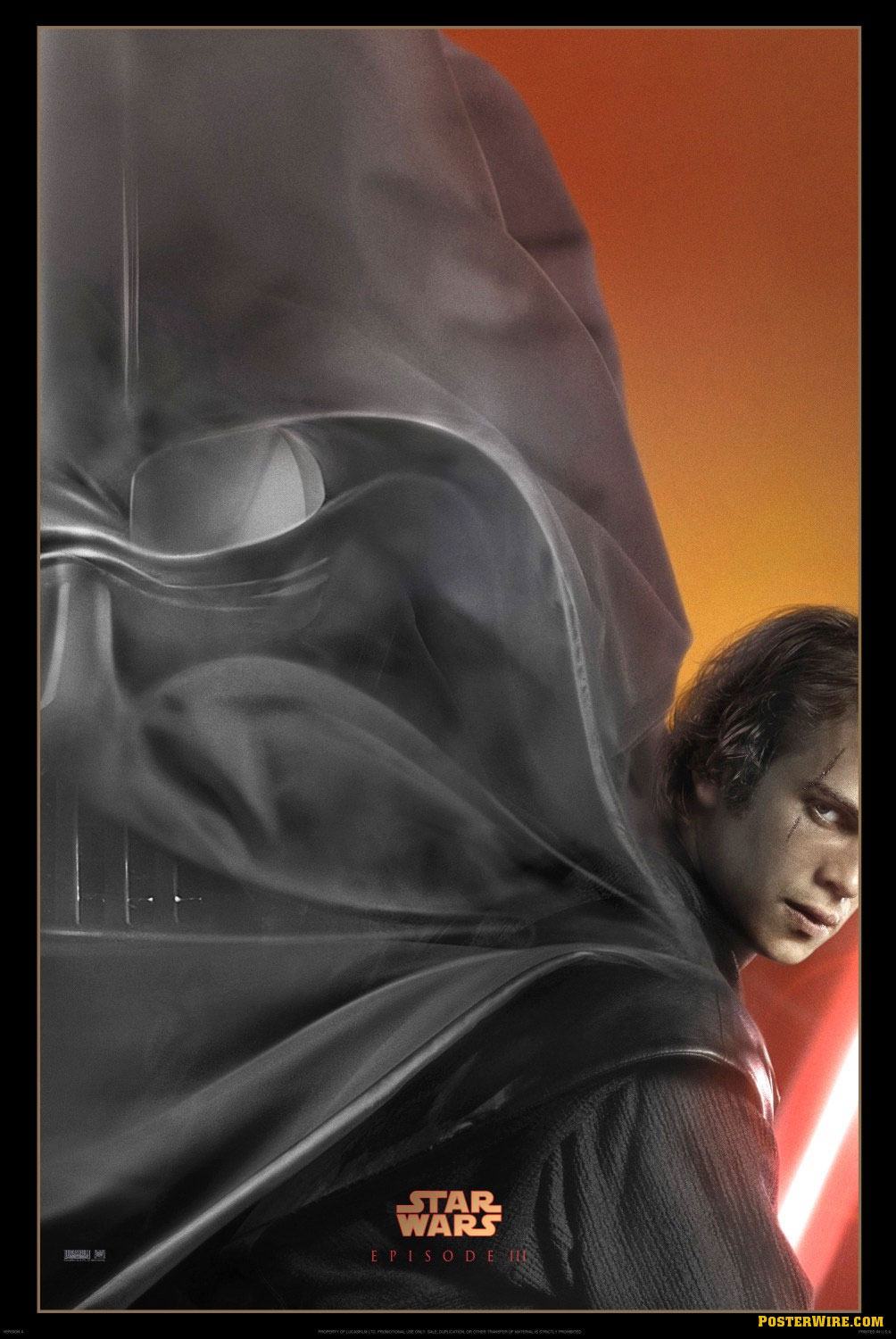
 While the second shows Anakin's future as Darth Vader.
Dark and light are major themes in all Star Wars films, not only because of the space setting but also because the stories are about the struggle between good and evil, and the use of darkness could symbolise death winning in the film: the Sith's revenge of the title.
Like the Dark Knight Rise's Lucas used the idea that this would be the last film, or rather 'complete the circle' and so marketing focussed on that element as well as the 'birth' of Darth Vader.
Another character poster focussed on this idea of Anakin turning, with a picture of him moving, and his cape creating the Dath Vader mask. The red lightsaber also would tempt fans, as showing both the character of Anakin with a 'Sith lightsaber' without the suit would show his 'death' and the 'birth' of Darth Vader within the film itself. (Vader is the name given to Anakin when he becomes part of the Sith, the suit was created as Vader received several injuries fighting his former master Obi-Wan on the planet Mustafa, as shown in the theatrical trailer and poster).

The Dark Knight Rises
Poster
Two have so far been released, one the iconic symbols created by falling buildings and the other a broken bat mask with Bane in the background. This corresponds to DKR being Nolan's last Batman film and has led to speculation to a story like "The Man who Broke the Bat". As well as the images, the dark colour scheme reflects the character and the storyline. This will draw fans of the films in, because they will want to see how Nolan's trilogy will end.


Trailer
Magazine Cover

 All three focus on the falling of Gotham, while the trailer makes reference to Bane, it is the magazine cover which shows Bane completely. All three use the iconic Bat symbol, as this is now recognisable as the Batman logo. In the trailer we see Gordon in hospital, and the new teaser poster is reminiscent of Bane story where he breaks Batman's back. By displaying 'The Ultimate Exclusive' at the top, it means more people will buy the magazine, particularly as the film featured is the sequel to one of the most critically acclaimed films of recent years, and so will pique not only Batman fans interests, but those who love blockbusters and thriller films in general
Scott Pilgrim Vs the World
Film Poster
A collection of posters were released for the film, including character and teaser posters. The character posters focus on Ramona's evil exes.


 All the posters focus on the character of Scott and his antagonists, without giving away too much of the story.
Film Trailer

Film Poster
A collection of posters were released for the film, including character and teaser posters. The character posters focus on Ramona's evil exes.

This is the teaser poster, used on products such as OST's as well as promote interest, and shows Pilgrim creating the title from his guitar playing. This reflects the tone of the film due to the amount of visual elements within it, giving it the representation of the graphic novel, as well as the fact one of the plot points is Scott being in a band.
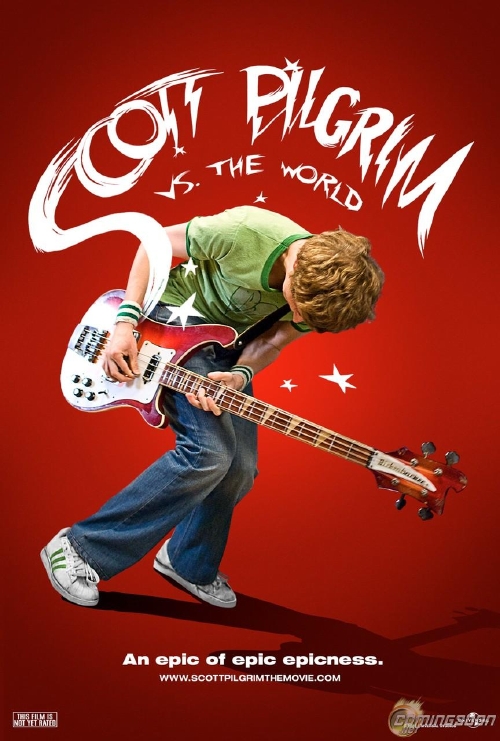
A 3D motion poster was also released, showing Pilgrim playing the guitar in different poses, and like the original poster shows that music is a big part of the film.

The final international poster features, Pilgrim, Ramona and the Evil Exes, and was also used for the cover of the DVD and Blu-Ray. This introduces the idea of Scott, the 'Guitar Hero' symbol gives the audience a clue as to the amount of cultural references in the film, while Ramona's pose adds to her 'mystery'. The logo on this poster better reflects that used in the comics, and so provides a link there

Film Trailer
This trailer focuses on introducing the idea of the story and league of evil exes, without ruining too much of the story. This is because the series of books is not as well-known as Spiderman or the X-Men, and so an introduction to the narrative would be needed so that viewers would not be confused by the trailer, and put off seeing the film
Magazine cover
The magazine front cover features Pilgrim using the flaming 'Power Of Love' Sword (the more well known out of the two featured in the film) he uses in the final fight against Gideon Graves and the red motif which is is the main colour for the marketing campaign. At the top of the page is an 8-bit Scott head, which is used within the film and other merchandise as a '1-up'. The text makes it look like a comic book cover. Red is used through much of the marketing campaign because it is the colour of love, a major theme in the film. As well this, courage is often associated with the colour red, which is something Scott gains through the course of the film. Cult film lovers may also buy the magazine because of the mention of Shaun of the Dead and Hot Fuzz, due to the connection with the director.
.
Star Wars Episode III: REVENGE OF THE SITH
For the final episode of the new trilogy, all the media was focussed on one event: The turning of Anakin Skywalker and the transformation into Darth Vader. This could explain why the villain is centrepiece on EMPIRE magazine's most popular cover:

For the final episode of the new trilogy, all the media was focussed on one event: The turning of Anakin Skywalker and the transformation into Darth Vader. This could explain why the villain is centrepiece on EMPIRE magazine's most popular cover:

The trailer focusses on the journey that turns Anakin, and while it contains spoilers, it isn't a surprise to anyone who has seen the original trilogy before the prequels:
It focusses on the action and Anakin becoming Darth Vader because they are the two things most likely to bring back fans after both the Phantom Menace and Attack of the Clones were not well received by critics and fans, who said the films were too political compared to the original trilogy, and that elements like Jar-Jar Binks made the core audience more for children. Because of this he is given a very small role in the film and is not featured in the trailer at all. Most of the dialogue relates to the war and Anakin's relationship with Chancellor Palpatine, which makes the film look more exciting to those who haven't seen a Star Wars film.
Two posters were created for the UK release of RotS, the first looking like a 'traditional' Star Wars poster

Dark and light are major themes in all Star Wars films, not only because of the space setting but also because the stories are about the struggle between good and evil, and the use of darkness could symbolise death winning in the film: the Sith's revenge of the title.
Like the Dark Knight Rise's Lucas used the idea that this would be the last film, or rather 'complete the circle' and so marketing focussed on that element as well as the 'birth' of Darth Vader.
Another character poster focussed on this idea of Anakin turning, with a picture of him moving, and his cape creating the Dath Vader mask. The red lightsaber also would tempt fans, as showing both the character of Anakin with a 'Sith lightsaber' without the suit would show his 'death' and the 'birth' of Darth Vader within the film itself. (Vader is the name given to Anakin when he becomes part of the Sith, the suit was created as Vader received several injuries fighting his former master Obi-Wan on the planet Mustafa, as shown in the theatrical trailer and poster).
Representation of Different groups
Different films represent different types of people in certain ways. For instance, in American Action films, the protagonist is always a military man or bodybuilder, while the antagonist is foreign, normally a country that America has 'defeated' in previous wars, such as the British, Russians and more recently the Middle East. They are normally portrayed as wanting to destroy the 'American way of life' and the hero always wins without so much as a scratch, showing America to be 'invincible'. Sometimes the protagonist stereotype has been challenged successfully. For instance in Rambo the protagonist is a Vietnam veteran who is on the run from American authorities.
Representation is quite different in Thriller films. For instance although women are often used as the protagonist, it is more likely to be a male as the hero, although modern action thrillers such as 'Salt' have used female protagonists. The adaptations of Girl With the Dragon Tattoo make the female protagonist a genius hacker, and do not conform to stereotypes in terms of her personality, looks or sexuality, although this is mainly due to the source material. There is no set representative group in Thriller films as such, as using obvious character archetypes would not build tension in the same way that going against conventions arguably would. An early example of a thriller that does this is Alfred Hitchcock's 'Psycho', which initially makes the audience believe that Marion Crane, a female is the main character, when in fact is the titular Psycho, Norman Bates, who we follow after Crane's death, now an infamous scene. Sometimes a well-established character may be explored in new ways, such as the Guy Ritchie Sherlock Holmes films, or even the Steven Moffat TV series, which places Holmes in a modern setting. These versions of Holmes differ considerably, due to their target audience, and the actors playing them. Steven Moffat's Sherlock, played by Benedict Cumberbatch, is a lot less unfeeling than Robert Downey Jr's portrayal, although Cumberbatch does warm to Martin Freeman's Watson. This could be due to the medium's which they are being broadcasted, the era's (Moffat's Sherlock is modern day, whereas Guy Ritchie's Sherlock Holmes is a typical Victorian London) or even the writers/directors.
Christopher Nolan is a very interesting case study when it comes to character representation. None of his characters are clear cut, and so we are never 100% sure of their motives. For instance, in Memento, his representation of the protagonist with Anterograde amnesia takes a completely different turn at the end of the film, and while the audience may still feel for him, it is for a different reason (he may have already killed the man he is after, and now others are using his condition for their own gain), and the portrayal is considered one of the most realistic of the conditions sufferers (the way the amnesia works, rather than the narrative works). However, this type of plot twist and revelation would not be as hard hitting for the audience if it wasn't for the non-chronological narrative structure, which is perhaps why Nolan does this, and why this film is so critically acclaimed, because we can empathise more with the protagonist. Nolan's portrayal of the Batman universe is also often applauded, and apart from the Joker, everyone has an agenda. Unlike previous incarnations, the characters are dark and realistic, and is more than likely done to stay close to the source material, but also because the previous Batman instalments (Batman Forever, Batman and Robin) were panned, not only because of their poor story-lines, but also because the characters had no depth and were aiming at children. Comparing the Tommy Lee Jones version of Two Face with Aaron Eckhart's, we know what the latter's motivation is, and what turned him from promising attorney, (Gotham's 'White Knight') into a man who depended on luck to make choices, but the former seems like a slapstick pantomime villain with an unrealistic mask. This character progression is seen in both of Nolan's films (apart from the Joker, but this ties in with his portrayal in the graphic novels), and none of the heroes are 100% good (much of Gotham's Police Department are corrupt) and the villains are not always truely evil (Ra's Al Ghul wants to make the world better, and trained Bruce Wayne, but believes humanity is the cause of its pain).
This type of character, flawed heroes and '3-Dimensional' villains (I.E. not the stereotypical Bond villain who only wants to take over the world) are one of the key conventions in most thrillers and so should be an idea seen in my final product.
Representation is quite different in Thriller films. For instance although women are often used as the protagonist, it is more likely to be a male as the hero, although modern action thrillers such as 'Salt' have used female protagonists. The adaptations of Girl With the Dragon Tattoo make the female protagonist a genius hacker, and do not conform to stereotypes in terms of her personality, looks or sexuality, although this is mainly due to the source material. There is no set representative group in Thriller films as such, as using obvious character archetypes would not build tension in the same way that going against conventions arguably would. An early example of a thriller that does this is Alfred Hitchcock's 'Psycho', which initially makes the audience believe that Marion Crane, a female is the main character, when in fact is the titular Psycho, Norman Bates, who we follow after Crane's death, now an infamous scene. Sometimes a well-established character may be explored in new ways, such as the Guy Ritchie Sherlock Holmes films, or even the Steven Moffat TV series, which places Holmes in a modern setting. These versions of Holmes differ considerably, due to their target audience, and the actors playing them. Steven Moffat's Sherlock, played by Benedict Cumberbatch, is a lot less unfeeling than Robert Downey Jr's portrayal, although Cumberbatch does warm to Martin Freeman's Watson. This could be due to the medium's which they are being broadcasted, the era's (Moffat's Sherlock is modern day, whereas Guy Ritchie's Sherlock Holmes is a typical Victorian London) or even the writers/directors.
Christopher Nolan is a very interesting case study when it comes to character representation. None of his characters are clear cut, and so we are never 100% sure of their motives. For instance, in Memento, his representation of the protagonist with Anterograde amnesia takes a completely different turn at the end of the film, and while the audience may still feel for him, it is for a different reason (he may have already killed the man he is after, and now others are using his condition for their own gain), and the portrayal is considered one of the most realistic of the conditions sufferers (the way the amnesia works, rather than the narrative works). However, this type of plot twist and revelation would not be as hard hitting for the audience if it wasn't for the non-chronological narrative structure, which is perhaps why Nolan does this, and why this film is so critically acclaimed, because we can empathise more with the protagonist. Nolan's portrayal of the Batman universe is also often applauded, and apart from the Joker, everyone has an agenda. Unlike previous incarnations, the characters are dark and realistic, and is more than likely done to stay close to the source material, but also because the previous Batman instalments (Batman Forever, Batman and Robin) were panned, not only because of their poor story-lines, but also because the characters had no depth and were aiming at children. Comparing the Tommy Lee Jones version of Two Face with Aaron Eckhart's, we know what the latter's motivation is, and what turned him from promising attorney, (Gotham's 'White Knight') into a man who depended on luck to make choices, but the former seems like a slapstick pantomime villain with an unrealistic mask. This character progression is seen in both of Nolan's films (apart from the Joker, but this ties in with his portrayal in the graphic novels), and none of the heroes are 100% good (much of Gotham's Police Department are corrupt) and the villains are not always truely evil (Ra's Al Ghul wants to make the world better, and trained Bruce Wayne, but believes humanity is the cause of its pain).
This type of character, flawed heroes and '3-Dimensional' villains (I.E. not the stereotypical Bond villain who only wants to take over the world) are one of the key conventions in most thrillers and so should be an idea seen in my final product.
Saturday, 3 December 2011
Genre Research
One of the most important aspects of marketing a film is knowing the genre of the text and the conventions that go with this. Every genre is different: Comedy, for instance, is a broad genre, but within it the audience expects the film to be funny. Therefore comedy films will do several things to their posters or any magazine covers to show the humour in one image. It might be that the main actors are in a comedic pose (See the poster for Dumb and Dumber, or the The Muppets as examples) or they may use different genre conventions in a different way. For instance, The Waterboy shows the main character in a stadium, like a poster for a sporting drama, but with a bucket in one hand. A Poster for Anchorman: the Legend of Ron Burgundy, meanwhile, is a take on many local American news broadcasters, who would advertise their shows in similar ways.
While the conventions of a Comedy is fairly straightforward, as other genres like Action or Sci-Fi, the conventions o a Thriller film is not so clear. I essence they have to 'thrill' the audience, hence the name, but by definition, surely if a film was 'thrilling' the term would apply to any film that audience member found enjoyable or exciting. But in essence, that is all thriller films do: provide excitement in films through suspense, tension and uncertainty. This is why so many Thriller films will have a plot twist or leave enigma's right until the end of the film.
There are also many sub-genres to the thriller genre. Psychological thrillers are designed to show mind-games and the main theme's relate to the mind. A good example of a psychological thriller is Memento, where a man suffering from a special type of amnesia tries to hunt down the man who gave him his condition and killed his wife. To add to the confusion, the narrative of the film is not chronological, jumping back and forth in almost the same way as the main character's condition is described (he only remembers the last few minutes of his life). Another example of this sub-genre is Shutter Island, which feature's Leonardo Di Caprio as a man hunting down an escaped prisoner in a lunatic asylum. Apart from the overlaying theme of the mind, there is no distinct character type, although in this sub-genre the characters may have an unknown or hidden backstory, which and be struggling with their identity.
Other sub-genres of thriller's include 'Crime Thriller's' which include film's like the Departed, or Zodiac, where either the antagonists identity is unclear, or there is double crossing by either one, or both sides, and techno-thriller's, where technology is one of the main causes for the problems face within the film, such as I, Robot . The characters aren't as clear cut as 'hero' and 'villain' which is the same for most thriller films.
Many directors past and present are renowned for their work in this genre. Almost all of Alfred Hitchcock's films are critically acclaimed thrillers, such as Psycho, the Birds and Rear Window, and more recently Christopher Nolan who made Memento and the updated Batman trilogy.
Essentially, Thriller films will place the protagonist in danger, often their past being hidden or false, and many of the enigma codes aren't revealed until the end of the film. None of the characters are completely good or evil, and there may be a social issue as a subtext.
While the conventions of a Comedy is fairly straightforward, as other genres like Action or Sci-Fi, the conventions o a Thriller film is not so clear. I essence they have to 'thrill' the audience, hence the name, but by definition, surely if a film was 'thrilling' the term would apply to any film that audience member found enjoyable or exciting. But in essence, that is all thriller films do: provide excitement in films through suspense, tension and uncertainty. This is why so many Thriller films will have a plot twist or leave enigma's right until the end of the film.
There are also many sub-genres to the thriller genre. Psychological thrillers are designed to show mind-games and the main theme's relate to the mind. A good example of a psychological thriller is Memento, where a man suffering from a special type of amnesia tries to hunt down the man who gave him his condition and killed his wife. To add to the confusion, the narrative of the film is not chronological, jumping back and forth in almost the same way as the main character's condition is described (he only remembers the last few minutes of his life). Another example of this sub-genre is Shutter Island, which feature's Leonardo Di Caprio as a man hunting down an escaped prisoner in a lunatic asylum. Apart from the overlaying theme of the mind, there is no distinct character type, although in this sub-genre the characters may have an unknown or hidden backstory, which and be struggling with their identity.
Other sub-genres of thriller's include 'Crime Thriller's' which include film's like the Departed, or Zodiac, where either the antagonists identity is unclear, or there is double crossing by either one, or both sides, and techno-thriller's, where technology is one of the main causes for the problems face within the film, such as I, Robot . The characters aren't as clear cut as 'hero' and 'villain' which is the same for most thriller films.
Many directors past and present are renowned for their work in this genre. Almost all of Alfred Hitchcock's films are critically acclaimed thrillers, such as Psycho, the Birds and Rear Window, and more recently Christopher Nolan who made Memento and the updated Batman trilogy.
Essentially, Thriller films will place the protagonist in danger, often their past being hidden or false, and many of the enigma codes aren't revealed until the end of the film. None of the characters are completely good or evil, and there may be a social issue as a subtext.
Monday, 28 November 2011
Linking Texts: Film Marketing and Synergy
All three products created as part of the A2 course must link together effectively. All three products (the Film Trailer, Poster and Magazine Front Cover) need to be related and create 'synergy'. Other forms of Synergy may include novelisations, OST's (Soundtracks), websites, tie-in games, and if it is for a children's film, figurines and models, as well as other memorabillia. Film promotions may also include 'viral marketing', using social media and other techniques to create brand awareness of products such as films.
Examples of this can be found for 'The Simpsons Movie' where '7-11' stores were changed into Resident stores 'Kwik-E-Mart's' and users could 'Simpsonize' themselves online, creating an avatar of themselves (or not) if they were part of the Simpsons. The marketers also held a competition between various 'Springfields' the fictional home of the Simpsons, to hold the premiere. This enabled Fox to keep the film in people's minds, and by having interactive elements to the campaign made the film more of an experience.
The Dark Knight held several viral events, all of which were later posted on a website, with mocked up Gotham newspapers. http://whysoserious.com/ These include, Harvey Dent campaign posters, a rollercoaster at Six Flags, a scavenger hunt at 'Comic-Con' and the reveal of the Joker, where fans emails revealed pixels. The prologue was shown before 'I Am Legend' in IMAX theatres. A similar campaign has started on the sequel 'The Dark Knight Rises' where tweeting #TheFireRises reveals the first image of antagonist Bane. The prologue for this film is scheduled to be released in IMAX before showings of 'Mission Impossible: Ghost Protocol. A manuscript from part of the prologue of the Dark Knight Rises was leaked to film website EMPIRE and technology site Wired.com, with parts cut out, making it look more official and secretive. These elements for both the Dark Knight and its sequel, allow fan's to create a 'hype' surrounding the film.
One of the most extensive examples of synergy in the last few years corresponds to the release of 'Scott Pilgrim Vs the World'. In the months before release there was:
Examples of this can be found for 'The Simpsons Movie' where '7-11' stores were changed into Resident stores 'Kwik-E-Mart's' and users could 'Simpsonize' themselves online, creating an avatar of themselves (or not) if they were part of the Simpsons. The marketers also held a competition between various 'Springfields' the fictional home of the Simpsons, to hold the premiere. This enabled Fox to keep the film in people's minds, and by having interactive elements to the campaign made the film more of an experience.
The Dark Knight held several viral events, all of which were later posted on a website, with mocked up Gotham newspapers. http://whysoserious.com/ These include, Harvey Dent campaign posters, a rollercoaster at Six Flags, a scavenger hunt at 'Comic-Con' and the reveal of the Joker, where fans emails revealed pixels. The prologue was shown before 'I Am Legend' in IMAX theatres. A similar campaign has started on the sequel 'The Dark Knight Rises' where tweeting #TheFireRises reveals the first image of antagonist Bane. The prologue for this film is scheduled to be released in IMAX before showings of 'Mission Impossible: Ghost Protocol. A manuscript from part of the prologue of the Dark Knight Rises was leaked to film website EMPIRE and technology site Wired.com, with parts cut out, making it look more official and secretive. These elements for both the Dark Knight and its sequel, allow fan's to create a 'hype' surrounding the film.
One of the most extensive examples of synergy in the last few years corresponds to the release of 'Scott Pilgrim Vs the World'. In the months before release there was:
- The final volume of the source material, Scott Pilgrim's Finest Hour was released by Oni Press.
- All 6 volumes of the graphic novel were released as digital versions through an iTunes app, costing slightly less and featuring bonus' for completing riddles (tap the screen corresponding to the clue). The film itself is based upon all 6 graphic novels, but uses the second volumes title.
- 3 soundtracks were released:
Two scores and an 'Original Motion Picture Soundtrack' which features songs from within the film, many inspiring Bryan Lee O'Malley when writing the graphic novel (Plumtree's Scott Pilgrim for instance) and those sung by Pilgrims band 'Sex Bob-Omb', written by Beck, and one of their rival bands, Crash and the Boys, written by Broken Social Scene. This album also features 8-bit versions of the 'Sex Bob-Omb' song Threshold and Beck singing some of the songs, rather than Sex Bob-Omb. A deluxe version of the album features more Sex Bob-Omb tracks sung by Beck and if downloaded online a video copy of 'The Clash At Demonhead' singing 'Black Sheep' (the album features the original Metric version). Soundtracks are often a popular piece of merchandising and many films will either have an Orchestral score or an original soundtrack, which shows the importance music has to the film - A downloadable game by Ubisoft, released on the Playstation Network and later, the X-Box Live Arcade. It is played in the style of an NES brawler (the graphic novel has several hints at retro video games), and features many easter eggs for fans of the comic and the film (The '1-Up' is used in the film and the game, and resembles the comic version of Scott). The game, much like the film, received a positive response and has a 77 on 'Metacritic', a website which rounds up review scores to produce an average. Many reviewers praised the retro feel and called it 'the best film tie in for some time'. When released on DVD and Blu-Ray, an add-on pack was released, which allowed gamers to get more use out of the game. While many video-game adaptations of films add in new villains or events, this is faithful to the original source material and so is similar to the author's original vision.
- T-shirts, either inspired by what is worn by characters within the film or by illustrations in the graphic novel.
- An animation produced by Adult Swim, which is the prologue found in the second volume of the graphic novel, and features the voices of the lead actors. This also introduced a 'new' character who isn't in the film, although it could be argued that dropping subplots was a good thing for this film. It also gave the audience who hadn't read the graphic novels more background into Scott's life before the film, which is vaguely touched upon.
- An EMPIRE magazine cover, which had exclusive behind the scenes access. The magazine later gave the film 5*'s. The cover is covered in more depth in an earlier blog post.
- Merchandise including key rings, figurines and bags.
- Around the home release, a box-set of Edgar Wright films was released on DVD and Blu-Ray, including Shaun of the Dead, Hot Fuzz and Scott Pilgrim. Many of the extra's on the three are quite similar, from a 'trivia track' to 'edited TV scenes' where the swearing is replaced by less offensive words. Shaun of the Dead's 'Funky Pete' version has since become a viral video.
Sunday, 27 November 2011
Film Trailer Research
The main product within my A2 coursework is a trailer, and so researching the conventions of trailers is something that I must do early on in the planning stages. I looked at several different film trailers for this research task. There are two main types of trailer: teaser and theatrical, of different lengths and which show different amounts of film. Teasers are shown during the films production in order to create awareness of the film, while Theatrical trailers are shown a couple months pre-release, where the film has been completed. A third trailer type is a 'TV Spot' which is normally around 30 seconds and shown around the time of the films theatrical run.
Firstly V For Vendetta, a dystopian Sci-Fi based on Alan Moore's graphic novel of the same name. It opens with flashes of images, mainly Natalie Portman's character Evie being captured and interrogated. After the brief conversation, it cuts to the studio logos before showing the dystopian society, where we get a narration by V. We see title graphics 'An uncompromising vision of the future' followed by 'from the directors of "The Matrix trilogy"'. We see acts of rebellion, and then the V symbol, while the title character says the famous rhyme 'remember, remember the fifth of November'.
From the opening shots of Evie being interrogated by an unseen man in the shadows, with a voice-over showing some of her 'crimes' we can see this isn't going to be an action film, and the Dystopia is akin to 1984. It also sets up the enigma of V's identity, as we only see a quick flash of him to begin with, and so this creates an air of mystery about him. Much of the shots hide his mask in the shadows (we never learn of his true identity). Once we see V fully however, the quick cuts featuring hand to hand combat and explosions show that as well as ideas and subtext, the film will also contain a lot of action. This will mean viewers who may not like a plot heavy film (for instance the Transformers series) would go and see this.
It also gives some background into the events that took place, with the bio-weaponry scene, and one image in particular is almost identical to one found in the film version of 1984, where the leader of the new UK is talking to thousands of people on TV, which is similar to the Big Brother speeches. This means that the films themes and tone should be instantly recognisable, as does the familiar London setting, which, if this is a UK trailer, means brings the ideals closer to home. Natalie Portman is selling this film, as she is the only actress named, and features prominently. This may be because the identity of V is a secret within the film, and so is in keeping with the character. The slow motion knives intercut between action shots at the end illustrate that it will be similar to the Wachowski's previous film the Matrix (mentioned as a title card) and V's monologue emphasises the mix between action and subtext. The fans of the graphic novel would see this, as well as those who like Thriller films, or even the Matrix films.
Another trailer I looked at was The Girl With The Dragon Tattoo. There are two distinct trailers for this, the first is a teaser, which features a version of Led Zeppelin's 'Immigrant Song' over a montage of images. The theatrical trailer, gives more of the story, and introduces the protagonists, Lisbeth and Mikael, as well as the plot, where Mikael has to write find a girls killer.
By using quick cut images which fans of the book will recognise, as well as key characters, it means that they will see similarities with the source text. The style of the lettering and the fact it was marketed as a 'feel bad' movie gives us an idea that the film is very serious in tone and that Lisbeth is more of an anti-hero. The version of 'Immigrant Song' is used because of Lisbeth's character, especially her portrayal in this version. The lack of dialogue but mention of source material may intrigue those who have yet to read the book. As well as this, Daniel Craig is featured extensively, possibly to entice Bond fan's to watch, although the themes are more like some of his art-house work. Both this and the full theatrical trailer give plot details, although this works as showing it is an adaptation of the books, rather than an original story, so giving away certain plot details (but not the main villain) works to it's advantage in this way. The original Swedish versions are considered one of the most popular foreign language films because of it's connection with the books, and so these trailers show that this version is like the source text but different from the original film adaptation. Because it has source material, the audience will mainly consist of fans of the original book but also of people who have not read the books but know how acclaimed they are.
Donnie Darko is a cult Sci-Fi film, for which a trailer was created for the Directors Cut release. After some title cards and a tagline, a mystery voice says wake up, to which we see an eye opening, followed by some symbols. The rest of the trailer is a montage of images from the film, with actors credits. The director credit appears over a shot of Donnie, before flashing up the film title, where we cut to a shot of 'Frank' and 'Are You Ready?'
By doing this, it creates intrigue, as not many of the actors were well known at this point, and the biggest name would have been Patrick Swayze, and so the audience would go to see in order to understand the trailer. However, the plot can be seen as confusing, which may put potential audiences off, especially as it is an original rather than adapted story. However, not giving away too much of the trailer works for thriller films like this, especially as this film is not considered a blockbuster, and so by showing that it is an 'Indie' film with some big plot ideas be attract some audiences
The Woman in Black is an upcoming Horror by Hammer Films. The trailer consists of a wide shot of Arthur Kipps standing at a train station, followed by the studio logos,. We then see a woman telling Kipps not to go to Eel Marsh House, before clips of him travelling and arriving there. A man talks about 'opening the door to superstition' where it cuts to Kipps opening the front door, where the three monkeys 'Hear No Evil, See No Evil, Speak No Evil' are seen on a mantle. We then see Kipps in a Victorian childs room, looking at some photos, and seeing the effects of 'the woman'. Text appears on a misty window 'The Door has Opened', before seeing a montage of clips. The point of this 'teaser' is to build tension for the audience and to create awareness of the film. It would attract horror fans, particularly those of the original Hammer company, as well as those who have seen the successful West End Show, possibly to see the similarities. Daniel Radcliffe is used throughout as a marketing tool, as he is a recognisable face in British cinema, having played Harry Potter for 8 films. This is his first major role outside the franchise, and so people would want to see his acting credentials in a different role.
Firstly V For Vendetta, a dystopian Sci-Fi based on Alan Moore's graphic novel of the same name. It opens with flashes of images, mainly Natalie Portman's character Evie being captured and interrogated. After the brief conversation, it cuts to the studio logos before showing the dystopian society, where we get a narration by V. We see title graphics 'An uncompromising vision of the future' followed by 'from the directors of "The Matrix trilogy"'. We see acts of rebellion, and then the V symbol, while the title character says the famous rhyme 'remember, remember the fifth of November'.
From the opening shots of Evie being interrogated by an unseen man in the shadows, with a voice-over showing some of her 'crimes' we can see this isn't going to be an action film, and the Dystopia is akin to 1984. It also sets up the enigma of V's identity, as we only see a quick flash of him to begin with, and so this creates an air of mystery about him. Much of the shots hide his mask in the shadows (we never learn of his true identity). Once we see V fully however, the quick cuts featuring hand to hand combat and explosions show that as well as ideas and subtext, the film will also contain a lot of action. This will mean viewers who may not like a plot heavy film (for instance the Transformers series) would go and see this.
It also gives some background into the events that took place, with the bio-weaponry scene, and one image in particular is almost identical to one found in the film version of 1984, where the leader of the new UK is talking to thousands of people on TV, which is similar to the Big Brother speeches. This means that the films themes and tone should be instantly recognisable, as does the familiar London setting, which, if this is a UK trailer, means brings the ideals closer to home. Natalie Portman is selling this film, as she is the only actress named, and features prominently. This may be because the identity of V is a secret within the film, and so is in keeping with the character. The slow motion knives intercut between action shots at the end illustrate that it will be similar to the Wachowski's previous film the Matrix (mentioned as a title card) and V's monologue emphasises the mix between action and subtext. The fans of the graphic novel would see this, as well as those who like Thriller films, or even the Matrix films.
Another trailer I looked at was The Girl With The Dragon Tattoo. There are two distinct trailers for this, the first is a teaser, which features a version of Led Zeppelin's 'Immigrant Song' over a montage of images. The theatrical trailer, gives more of the story, and introduces the protagonists, Lisbeth and Mikael, as well as the plot, where Mikael has to write find a girls killer.
By using quick cut images which fans of the book will recognise, as well as key characters, it means that they will see similarities with the source text. The style of the lettering and the fact it was marketed as a 'feel bad' movie gives us an idea that the film is very serious in tone and that Lisbeth is more of an anti-hero. The version of 'Immigrant Song' is used because of Lisbeth's character, especially her portrayal in this version. The lack of dialogue but mention of source material may intrigue those who have yet to read the book. As well as this, Daniel Craig is featured extensively, possibly to entice Bond fan's to watch, although the themes are more like some of his art-house work. Both this and the full theatrical trailer give plot details, although this works as showing it is an adaptation of the books, rather than an original story, so giving away certain plot details (but not the main villain) works to it's advantage in this way. The original Swedish versions are considered one of the most popular foreign language films because of it's connection with the books, and so these trailers show that this version is like the source text but different from the original film adaptation. Because it has source material, the audience will mainly consist of fans of the original book but also of people who have not read the books but know how acclaimed they are.
Donnie Darko is a cult Sci-Fi film, for which a trailer was created for the Directors Cut release. After some title cards and a tagline, a mystery voice says wake up, to which we see an eye opening, followed by some symbols. The rest of the trailer is a montage of images from the film, with actors credits. The director credit appears over a shot of Donnie, before flashing up the film title, where we cut to a shot of 'Frank' and 'Are You Ready?'
By doing this, it creates intrigue, as not many of the actors were well known at this point, and the biggest name would have been Patrick Swayze, and so the audience would go to see in order to understand the trailer. However, the plot can be seen as confusing, which may put potential audiences off, especially as it is an original rather than adapted story. However, not giving away too much of the trailer works for thriller films like this, especially as this film is not considered a blockbuster, and so by showing that it is an 'Indie' film with some big plot ideas be attract some audiences
The Woman in Black is an upcoming Horror by Hammer Films. The trailer consists of a wide shot of Arthur Kipps standing at a train station, followed by the studio logos,. We then see a woman telling Kipps not to go to Eel Marsh House, before clips of him travelling and arriving there. A man talks about 'opening the door to superstition' where it cuts to Kipps opening the front door, where the three monkeys 'Hear No Evil, See No Evil, Speak No Evil' are seen on a mantle. We then see Kipps in a Victorian childs room, looking at some photos, and seeing the effects of 'the woman'. Text appears on a misty window 'The Door has Opened', before seeing a montage of clips. The point of this 'teaser' is to build tension for the audience and to create awareness of the film. It would attract horror fans, particularly those of the original Hammer company, as well as those who have seen the successful West End Show, possibly to see the similarities. Daniel Radcliffe is used throughout as a marketing tool, as he is a recognisable face in British cinema, having played Harry Potter for 8 films. This is his first major role outside the franchise, and so people would want to see his acting credentials in a different role.
Sunday, 20 November 2011
Film Poster Research
One of my Ancillary products is a Film poster and so for part of the research it makes sense to write about a variety of ready made film posters.


The V For Vendetta poster is set out as a propaganda poster, which fits into the dystopian warlike state of which it is set. The two main characters are shown, as are the words ‘Freedom! Forever!’. Multiple images of V are reminiscent of the final set piece, while the silhouette of the Houses of Parliament is also significant plot wise. The director’s previous work is mentioned. The iconic mask is also seen but not completely.
This shows to the viewer that the film is dystopian and reminiscent of Orwell's 1984. As well as this, it conveys a serious tone, meaning the film is more likely going to be a thriller or drama with subtext.

This is the original poster for Star Wars. It features Luke and Leia posing on the rocks of Tatooine (due to the shelters and desert environment seen in the background) while in space there are X Wings and the Death Star, which gives an indication of the films genre.
We also have C3PO and R2-D2 near Luke and Leia, showing that they are also protagonists, while Vader’s helmet is in the sky by the Death Star giving him the appearance of the main villain.
All these elements convey a typical Sci-Fi poster, while the hero and heroine shows the film isn't a typical 'Damsel In Distress' adventure.
We also have C3PO and R2-D2 near Luke and Leia, showing that they are also protagonists, while Vader’s helmet is in the sky by the Death Star giving him the appearance of the main villain.
All these elements convey a typical Sci-Fi poster, while the hero and heroine shows the film isn't a typical 'Damsel In Distress' adventure.
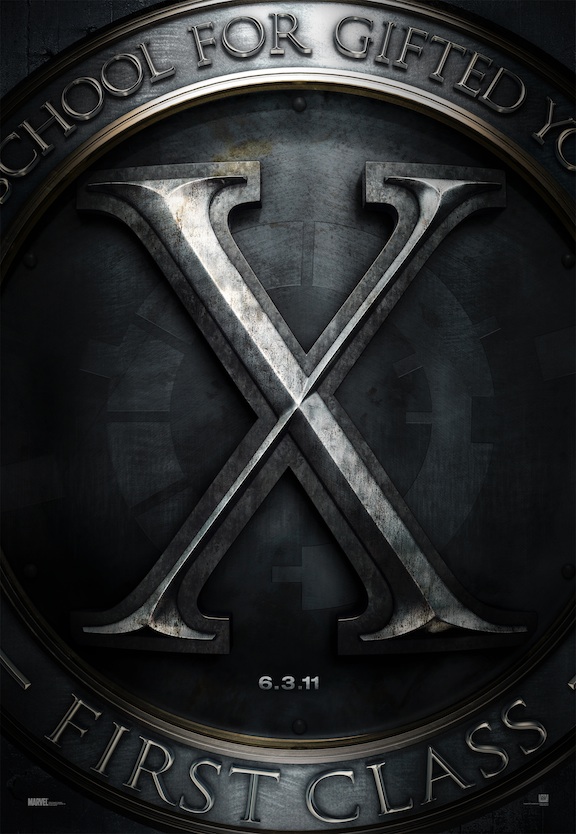
This is an example of a teaser poster. This example for ‘X-Men: First Class’ only features a date and a logo for ‘Xavier’s School for the gifted and talented’ on it. The title at the bottom gives us a clue as to what era the film takes place in the X-Men canon.
While it doesn't show any characters or locations, it means that people, especially fans will start talking about the film, and raise awareness.
While it doesn't show any characters or locations, it means that people, especially fans will start talking about the film, and raise awareness.
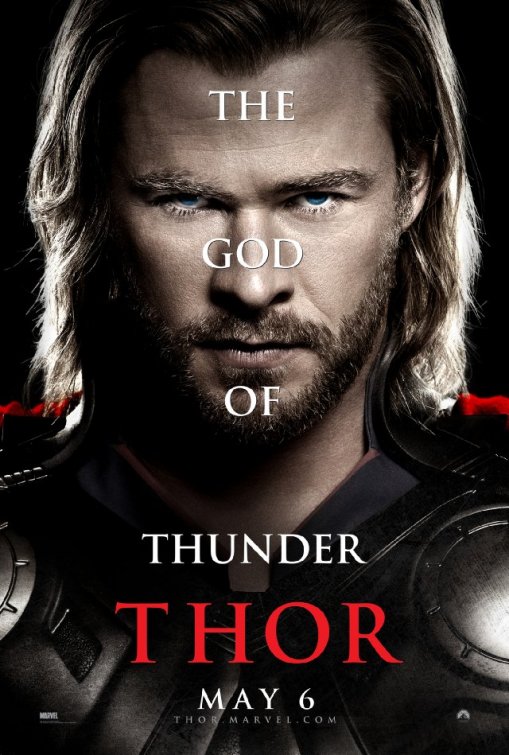
This is a character poster for Thor, featuring a close-up of Thor’s face. There is overlaying text saying that he is the God Of Thunder, whereas other character posters will talk about the nature of the other characters. A date is given as is the title, and we see part of the costume, which is significant given that it is an adaption of a Marvel comic (the MARVEL logo is seen at the bottom). This is the only indication we get that it is a superhero film. The costume has a cape which gives the impression of a superhero or royalty (he is technically both) and the armour makes us think of an impending war.

This is the character poster for Sherlock Holmes: A Game Of Shadows, featuring Robert Downey Jr as the main character and Jared Harris in the background as Moriarty, the films antagonist. Behind Holmes is a Victorian London backdrop, giving the audience of a setting. What little of Holmes costume we see shows that this is not a ‘typical’ Sherlock Holmes film. Ritchie’s remakes are more in the style of his previous films and focus more on action and spectacle, evidenced by Holmes gun being one of the posters focal points.
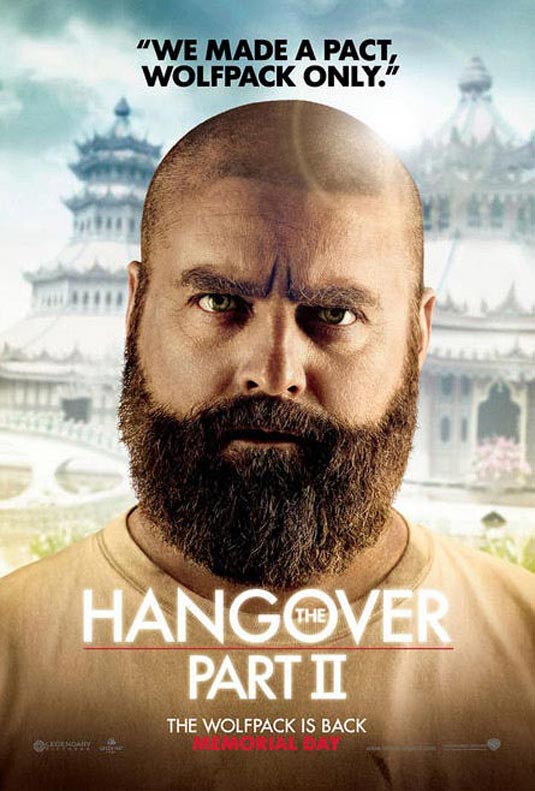
This is a character poster for the ‘Hangover Part II’ with Zach Galifianakis’s character Alan. His head is shaved, creating a difference between the original and the sequel, and adds in the idea of chaos in a new place. This is an American poster, as the release date is ‘Memorial Day’ an American holiday. Alan’s confused look plays into the idea that he is a ‘man-child’ and the ’wolfpack’ is one of his ideas.
Because the Hangover Part II posters are character posters, they are relying on the audience's knowledge of the original, and love of the characters to get them to see this film. The quote at the top helps us to identify with the specific character, and the backdrop gives us an idea of a different location.
This is the poster for Harry Potter and Deathly Hallows part 2. The ‘IT ALL ENDS’ tagline relates to this being the final film in the series . No title is given, as the film is seen as a ‘cultural phenomenon’, but we see the main characters standing outside the ruins of Hogwarts. The expressions and clothing indicates that this is going to be full of effects, a ‘wizarding war film’ as some reviewers described it.
The poster sells the film in two ways, firstly the success of the Harry Potter franchise (the use of the three main characters) and the fact it will be the final part of the series.
The poster sells the film in two ways, firstly the success of the Harry Potter franchise (the use of the three main characters) and the fact it will be the final part of the series.
Subscribe to:
Posts (Atom)