Saturday, 14 April 2012

A2 Evaluation


1.       In what ways does your product use, develop or challenge forms and conventions of real media products?

My main product uses and develops thriller trailer conventions. One of the ways it does this is to show the protagonist, and not the main antagonist (secondary antagonists are shown to provide enigma codes). The protagonist is shown to be extraordinary, through the events shown in the trailer (investigating murders, fighting off people almost twice her size). Because it is a thriller trailer, there are not any ‘scares’ and comedic moments, which helps set the films tone as something serious and to an extent realistic, which is what most thriller's tend to do with their narratives, unless it uses future technology or ideas. As well as this, the trailer gives information about the film, such as release date, title and tagline. Although some of my feedback believe that 'too much' of the story, much of this is in the beginning of the narrative, taking place before much of the main plot, and so does not challenge trailer conventions.
My narrative sticks to the conventions of a thriller film, particularly the conspiracy Thriller sub-genre. The conspiracy is the main part of the trailer, but is not spoiled (the audience knows there is a conspiracy but does not know why).The main reason for this is because of spoilers: trailers do not give away the ending of a film, otherwise the audience would not see the film. This is a convention I have definitely used, and the trailer does not use any part of the end narrative, much of it being either early on in the film or flashbacks to explain character.
 If I were to redo this trailer, I would change the opening sequences to show more of an introduction to Alex (the main character), which is more in keeping with certain trailers, which means that my end product challenges certain conventions. This introduction to Alex could have been clips of her doing investigations, and at award ceremonies etc, although it would not have been feasible to stage all of this

The ancillary tasks also used and developed conventions. The magazine cover features the protagonist in a specially shot pose for the cover. Although my cover shows her looking at some evidence, on a single coloured background, there are variations, in mainstream magazines, such as the character staring out of the page, or the background being a scene from the film. The colour was chosen because grey is a fairly moody/serious colour, but it also makes foreground objects stand out more than black. A red or yellow background would have made the film seem more light-hearted, and so the use of grey shows that the film is meant to be serious. The pose where a character is looking at a prop is one of the most common, however. As well as this, there is a top banner advertising another magazine feature, as well as other films featured in the magazine. All the main product details, such as issue, date and price are on the cover, and also use typical conventions, as the title of almost every magazine is near the top, below either a banner of part of the background image. This is done so that the title stands out in newspaper shelves and so would make little sense to challenge this convention. The title chosen uses the convention of being related to the subject it covers, as a spotlight is often used on stage or by actors, and also 'putting the spotlight on something' means looking at it in more depth, which is what most magazines do to the cover film/feature.
If I were to change anything, I would either have Alex in a different pose, or add in a secondary character (likely the editor) and have a secondary cover featuring different characters, which aren't the main villains. While some films use magazine covers to 'reveal' their villain/hero's look (many of the EMPIRE ones, such as Girl With the Dragon Tattoo, Dark Knight and Rises), although that is because these characters are cultural icons, while the identity of the Message's villain is one of the key enigma codes. 


The Poster could be seen as a typical character poster, detailing a sole character, on a single coloured background, with something to describe them. While some posters use a quote, many (including my poster) use a description of the character, in this case 'A Brilliant Mind', which is a convention I decided to use, as it helped the audience to understand the character more. Like many character posters/banners, it is quite minimalist, and so works to intrigue the audience without giving the plot (ie key location, narrative detail) away. The colour was chosen because it is a serious colour, and shows the film is not light-hearted, as well as giving a link to the magazine front cover. The name and release date is given, which is one of the main features of a poster, as it is used to advertise a film close to its release date or during its theatrical run, especially character posters.
If I were to do this again, I would use images of other major characters, such as the two police officers and the editor, as well as Alex, or create other character posters to symbolise their relationships with each other. However, I would not put any of the villains on the cover, as that is one of the films enigma codes.

2.       How effective is the combination of your main product and ancillary tasks?
There are many ways in which the Message trailer is linked to the magazine cover and poster.
Firstly all three feature Charli (as Alex Davidson) and she is the sole character in the magazine and poster, although the poses are different.
All three feature the title, and the poster and the trailer use similar font for it, which was done to show that the film being marketed is the same, and to keep consistency through marketing tools. The font is also reminiscent of a type-writer which is often associated with thrillers and conspiracies, due to their use before computers were publicly available. The magazine would have a house style and so would not use the same logo, however, but the title font on it is still similar to that on the trailer/poster. The remaining text on the trailer is used to describe Charli's character, as the words a 'brilliant mind' appear on both, as character posters normally have a description or short quote about the character, and quote demonstrates how her character is seen or portrayed in the film, and is not seen differently to different people. The effectiveness would not be as great if the same character was described in different ways, as this may confuse the audience. The date and film studio appear in both the trailer and on the poster, while the date of the magazine is earlier in the year. This is however very common, and films will normally have a cover a few months before release, either new information or the big reveal. It also means that the promotional trailer and poster would be released at the same time, as release dates may change, or the information may not be known. However, it may also be that this one element is simple to edit, and is also something which is key, as different dates would confuse an audience, lower it's effectiveness and therefore how many people would watch the film. The background colour's on the magazine cover and the poster are the same, which provides another link, as well as emphasising the tone (light hearted or comedies would have lighter backgrounds. Thrillers tend to be dark). This was mainly done to show the tone, but also because of recognisability, as certain colours may be associated with films (AVATAR and blue, The Expendable's and yellow for instance), and so using a grey colour that wasn't metallic would likely stick in the mind of the target audience (for instance grey was also used for marketing 'Taken' another thriller)

While all three share common links, they can all be viewed as individual products, rather than just Photoshopping a still from the trailer, new specially shot images are used.
From the feedback I have gained on all three products, I would say that the combination is effective.

3.       What have you learned from your audience feedback?

One of the things that I made sure I did was get feedback from my target audience throughout the production stage. For instance, once I had created my first version I asked for feedback and then made changes based upon it. For instance, in the first cut some felt that the death scenes were either too long or too short, depending on the character, and so these scenes were edited accordingly. As well as this, some felt that James' character was not explained properly, and so extra text was added. As well as this, more title screens were added, and an extra scene shot, which took care of any other complaints. 
After creating the second version my audience feedback became more positive, although some constructive criticisms had also been given.
A short comment, only saying that their favourite part was James' speech as Prime Minister


This user also enjoyed the trailer, and stated they would  see the film for the story shown in the trailer


This user has more knowledge in the field, having taken a media course already. While she enjoyed the piece and commented on the good use of editing, she was also able to give some constructive criticisms.

This next user liked the piece but commented on the actors smiling during takes


This was the comment left by James, who played the PM. He enjoyed the piece but also commented on some shots and other parts which may not have been perfect.


As well as Facebook, I put the link on Twitter to get more feedback. One of these users, @ITFCAston did give some positive feedback, as well as some constructive criticism's.


These are just a few examples of the feedback received, with the rest being similar to these examples. From this I have found that the trailer was well received but some of the camera shots were not straight, and some felt that there was too much of the story revealed, through the deaths of the five people. However, they would take place before the main narrative and would not be considered spoilers. If remade that part of the trailer could be made clearer. As well as this YouTube allows users to view statistics on their video's


My audience profile listed the main viewer between 18 and 25, and more likely male, which is what these statistics appear to show. 
From both pieces of feedback I have learned that not everything works with all people, for instance, some knew why James' PM was included, most didn't, which is why extra information was added. I also found that my audience research allowed me to create a film that appealed a lot more than it would have done if I had just drafted a story, which shows its importance. I didn't realise how much narrative and back-story was needed until my first set of feedback, which meant that I could adjust the trailer accordingly, without giving away spoilers. Finally, while not everyone gave the same feedback, much of it was similar, and included things which I had not thought of (title cards for back-story), which shows that the audience know what they want, and my target audience wants to understand the characters and their motives, even in the trailers.

4.       How did you use media technologies in the construction and research, planning and evaluation stages?
Different types of technology have been used at all stages of the coursework piece, from planning and research to construction and evaluation. For instance, I have used both Mac’s and Windows 7 PC’s to create my media pieces. The Mac was used primarily to create my main product (trailer) using Final Cut Pro. This enabled me to use layering, add in audio and edit pieces non-destructively. Special effects can also be used. For instance, one scene in the trailer is a news conference with the Prime Minister. To achieve the look, I created a banner in Photoshop and used it as an overlay. After this I removed the background of the actor speaking (it was filmed behind a ‘blue screen’ to make this process easier), and replaced it with a still image of 10 Downing Street. Once all the layers were sorted out it was only a case for moving them into the correct position. This allowed me to make the scene look more realistic than it would have been on a plain background, and make's the sequence look more real in another way: it looks like it is being shown on a TV news network, which is how that kind of shot would be shown. While the picture is static, this does not detract from the effect created, as the viewer would be focussing on James rather than the banner.
As well as this, I could mix in different audio and edit sound levels, which meant that if I had to replace audio, or create a voice-over (which occurred during the flashback shots) it meant that I could line both the audio and video to a frame.
Photoshop was also used to create my ancillary tasks. They were achieved by using the magnetic lasso tool to cut out the main character, before moving this image to a separate layer. Then, I used the background colour tool to change the background. This meant that the object of the cover/poster was the character, and the locations did not give away plot details, and that unwanted parts of the photo could be taken away easily. Then I used Office software to add in any text needed for the poster and magazine cover. By using Microsoft Publisher, rather than Photoshop itself, I could move text more easily, as well as use the 'template's' options which meant that mastheads and other information would automatically be in the correct place, and would not be accidentally be overwritten due to the layers.
Other software used includes ‘Oxelon’ which allowed me to convert my footage to a Final Cut friendly format. This was done as the other alternative was to use a 'director's box' and import using iMovie, which often led to varying results (unwanted visuals such as menu screens or battery meter) 


The internet played a big part in the research and planning stages. For instance, using YouTube to view existing trailers, Blogger was used as a way of creating the coursework portfolio and social networks like Twitter and Facebook to get audience feedback, which was one of major parts of the evaluation stages. YouTube was also used to upload my final trailer. This site was used because it is part of Google, like Blogger, and is the world's biggest streaming site. As well as this, part of the research involved going onto different film magazine websites, like Total Film and EMPIRE, to get past magazine covers, although TF did not have them in a separate section, which is why the post mainly consists of examples from Empire

Monday, 26 March 2012

The Message Bloopers

The final trailer for my coursework 'The Message' went up yesterday. As well as this I also uploaded a collection of out-takes that happened while filming. Some of the locations changed based on either feedback or practicality, as did some of the actors, for the same reasons

Sunday, 25 March 2012

Second Version of The Message Trailer


In the second version I made some changes based upon the feedback I received. Firstly I changed the background on James' speech to 10 Downing Street, making it look more 'official'. While this worked in a similar way to adding the news channel banner (layering on Final Cut Pro), something happened during the beginning causing some movement and the top of James' head to disappear momentarily. However, the effect was achieved by cropping James and filtering out the background.
Other changes to this version were: using a different actor to portray Robert King, as I found the scene too dark, and some felt that he was the one mugging Chloe's character in a previous scene. As he had other commitments, a new actor was found, a different location used, and I made sure the clothing worn was different.
Text was added to give more depth to the victims, and some of the title graphics were added/moved, depending on feedback. Finally a new scene was added, naming (or at least partly) the organisation behind it as 'The Order', which could be seen as adding to the enigma of the trailer

The Message: Linking Texts

There are many ways in which the Message trailer is linked to the magazine cover and poster.
Firstly all three feature Charli (as Alex Davidson) and she is the sole character in the magazine and poster, although the poses are different.
All three feature the title, and the poster and the trailer use similar font for it, which was done to show that the film being marketed is the same, and to keep consistency through marketing tools. The font is also reminiscent of a type-writer which is often associated with thrillers and conspiracies, due to their use before computers were publicly available. The magazine would have a house style and so would not use the same logo, however, but the title font on it is still similar to that on the trailer/poster. The remaining text on the trailer is used to describe Charli's character, as the words a 'brilliant mind' appear on both, as character posters normally have a description or short quote about the character, and quote demonstrates how her character is seen or portrayed in the film, and is not seen differently to different people. The effectiveness would not be as great if the same character was described in different ways, as this may confuse the audience. The date and film studio appear in both the trailer and on the poster, while the date of the magazine is earlier in the year. This is however very common, and films will normally have a cover a few months before release, either new information or the big reveal. It also means that the promotional trailer and poster would be released at the same time, as release dates may change, or the information may not be known. However, it may also be that this one element is simple to edit, and is also something which is key, as different dates would confuse an audience, lower it's effectiveness and therefore how many people would watch the film. The background colour's on the magazine cover and the poster are the same, which provides another link, as well as emphasising the tone (light hearted or comedies would have lighter backgrounds. Thrillers tend to be dark). This was mainly done to show the tone, but also because of recognisability, as certain colours may be associated with films (AVATAR and blue, The Expendable's and yellow for instance), and so using a grey colour that wasn't metallic would likely stick in the mind of the target audience (for instance grey was also used for marketing 'Taken' another thriller)

While all three share common links, they can all be viewed as individual products, rather than just Photoshopping a still from the trailer, new specially shot images are used.
From the feedback I have gained on all three products, I would say that the combination is effective.

Wednesday, 14 March 2012

Ancillary Tasks: Completed Poster and Magazine

These are the first versions of the Message Poster and the cover of a magazine titled 'Spotlight' where The Message is the cover film:
MAGAZINE COVER

This is very similar to the original draft of the cover.
It uses the conventions of magazines (name related to topic, at the top of the page), while the barcode and text for the extra features means this would be a retail version (many subscription covers will feature only the cover image and title, sometimes the cover image will be different for subscribers, especially if multiple covers are available for that issue). 


POSTER

While many aspects of this poster are similar to the draft, there is no longer any pictures of the five victims, and the text at the top of the poster is different (now a description of the character), making this now a character poster. Using my research on posters, I noticed that very few of the character posters had the Actor's names, unless they were Blockbuster action films, and so this is omitted on the final poster.

Like my main product, this has got a positive reception, with many saying that the poster looks better than some posters for real films, while other's said that they could imagine the magazine cover being on the shelf of a newsagents.

Sunday, 11 March 2012

First Version of the Message Trailer.

This is the first version of the main product: the trailer. From the feedback I have gained already I am going to add in extra titles and have quicker cuts in some sections.

Any Extra feedback on this version is welcome

Sunday, 26 February 2012

The Message: Fake Stories

The opening shots of The Message trailer are some stories showing Alex's work, awards she has won etc, printed in 'her' paper, titled 'The Daily Gazette'. The secondary stories relate to events by some of the victims. From a review of Robin McCarthy's new book, to the announcement of a new medicine (relating to Robert King), and a story about how Kurt Allen helped England win the Hockey World Cup. Apart from the first paragraph, the writing is stock due to the audience not seeing the text clearly. A mistake picked up later on in production was found: 2 articles had the same article text, but again this is not really noticeable.
These are the covers and certificates:
Certificate for Alex winning the 'Reporter of the Year' at the NJA's (National Journalist Awards), a fictional awards ceremony also mentioned in one of the reports.

A report where Alex's newspaper wins 5 press awards, of which Alex wins 2. The secondary headline is an exclusive review of Robin McCarthy's book 'Almost Midnight'. Robin is the 2nd victim, who is poisoned while writing the follow-up to this.

This relates to the certificate, where Alex wins Journalist of the Year, for the 4th time. The secondary article is about the miracle medicine keeping Robert King alive, although this is more subtle, as the article makes no mention of King, nor do we see King take the wrong medicine.


This is the final article, showing which reports Alex winning 3 BAFTA's for a current affairs show presented by her. The secondary story is on Kurt Allen captaining England in a 4-0 win at the Hockey World Cup.

The Message Cast List

This is the cast list for the characters within 'The Message' and notes on the role they are playing. Credits appear in order of appearance

Charli Bedford: Alex Davidson, a top journalist who uncovers a link between a series of unresolved deaths after a tip-off from an anonymous source, and must uncover the conspiracy before more people are killed.

Tom Foster: The Source, the one who gives Alex the information leading to the discovery of the 5th victim. While important to the plot, very little is known about him, and his face is never seen onscreen, wearing a hood in the trailer

Sam French: Jacob West, an art curator who is shot in mysterious circumstances before an exhibition starts. He is seen to be running away, and stumbles down the stairs, shot by a silenced pistol.

Emma Turner: Robin McCarthy, an author who's drink is poisoned while she writes her latest novel in a cafe.

Chloe Cronin: Angela Smith, A rights activist who dies after a 'mugging'. The mugger is played by Abi Eaton, who was originally going to be playing Robin.

Jay Hoggett: Robert King, a man who has been the public face of a new medical campaign that saved his life, dies from a heart attack after his medicine is switched. While this is not shown, this would be expanded in the full film, although a POV shot of the 'medicine' being taken is in the trailer. A report in the opening pan shows the 'miracle medicine' relating back to King.

Sam Driver: Kurt Allen, a famous Hockey player, found by Alex by the side of his training court. In real life, Sam does play hockey in goal for both Copleston High School, and Ipswich East Suffolk 4th.

Dan Widdowson: James Murphy, a journalist working for the same company as Alex, and the only person she trusts with the information. If this was a full film, Murphy would be a romantic interest to Alex, and would likely die or get severely injured towards the end of the film

James Parnell: The Prime Minister, the sixth target, who is going to be signing 'a historic bill' (the connection between the other victims) and the person who Alex must save.

Kaya Corbett: Janet Smith, a police officer who is working on the Kurt Allen case. Does not believe that Alex is guilty of killing him, and tries to help her when possible. Seen as part of a 'good cop, bad cop' routine in the trailer.

Matt Finch: Shawn Howard, a no nonsense officer who believes that Alex killed Kurt Allen, due to her ID being found at the scene. Similar character to the one Matt played in my AS coursework: DCI Howard. Although not the same character, they could be related.

Curtis Garrett: The Assassin, one of the people who is sent to kill Alex as she tries to work out who is behind the conspiracy, ultimately failing. Although not dressed as a 'typical' assassin, this reflects that anything could happen at any time, and that wearing normal clothing stops him from sticking out of the crowd.

The Message Ancillary tasks: Draft Poster and Magazine Cover

This is a post for the ancillary tasks for the Message: A magazine Front Cover and Poster.


1. Text 'UK Directors Special' gives magazine a feature to advertise, and relates to cover film as it would be a  British Film.
2.SPOTLIGHT!: Magazine Name and is related to films, implying type of magazine without specifying.
3.Date, Price and Web Information. Magazines are normally a month ahead (March issue released in February etc.)
4. Alex looking at document sets films tone and while similar is not the same image as the poster, implying it was taken specifically for the magazine. On a darker background, also setting films tone.
5.Other film stories relating to recent or upcoming films: Dark Knight Rises, The Avengers/Avengers Assemble (the latter is the new UK name), James Bond: Skyfall, The Muppets, Star Trek 2 and The Hobbit
6. Word Exclusive helps sell copies as the readers can't get the information elsewhere. Also ties in with the cover photo (shot for magazine) and message underneath
7. 'The only magazine on set' ties in to the word Exclusive
8.Small box with interviews, all relating to top banner (1.) and features British Actors and Directors from New and Upcoming films: Edgar Wright, Noel Clarke, Chris Nolan, Simon Pegg, Martin Freeman, Benedict Cumberbatch, Daniel Craig and more.
9. Publisher name and barcode, found on all retail copies but not necessarily subscriber ones.


1. Actor's name's appear at the top of the poster
2. Grey background to set tone of the film (also background of the magazine cover)
3. Alex stood facing the camera. Expression is curious to show mystery.
4. Shots of the five victims to show wider implications of the conspiracy
5. TITLE: The Message. 'Message' is a larger font than 'the', showing that it is the main part of the title. In a report style font.
6.COMING SOON: No release date but posters aim to raise film awareness
7.Studio Logos, most likely revise 'BlackJack Films', fictional production studio from AS coursework

The Message Storyboard

These are the original storyboards for 'The Message'. Note footage may change.


1.Studio Logos
2.Pan Across the reports and certificates Alex has earned, showing she is a top reporter.
3. Mid-shot of Alex, looking through report
4. Close-up of Alex, answering the phone
5. Close-up of the source, but we do not see his face
6. Shots of how the four victims died, in quick succession over a voice-over of their names from the source.
7. Long Shot of Alex looking for the fifth victim
8.Close-up of the fifth victim
9. Mid-shot of Alex looking through files again
10. Director Title Card
11. Two Shot of Alex and another Journalist speaking
12. Close-up of Journalist speaking


13. Mid-shot of victim 6, the Prime Minister, on a News Channel
14. Cut back to Alex at the table
15. Cut to Insert/Extreme Close-up of wallet/ID being picked up
16. Two shot of Police Officers knocking on a door
17.Shot Reverse Shot conversation between Alex and Police Officers
18. Actor Name Title Card
19. Two Shot of Alex fighting Assassin
20. Close-up of Assassin speaking
21.The Message Title Card
22.Release Date Title Card

Sunday, 5 February 2012

The Message Script

This is the script for my coursework piece. Names may change, and I have decided on naming the protagonist Alex as it could represent either gender. This is due to only having cast a few parts at time of writing.


THE MESSAGE TRAILER SCRIPT. PLEASE NOTE NAMES AND LOCATIONS MAY CHANGE
INT. OFFICE. NIGHT
Pan across wall, where we see several certificates and news covers.
Cut to ALEX sitting on a desk, looking over sources. The main light source is a lamp in shot.
CLOSE-UP of Alex talking to THE SOURCE. Cross-cutting is used in the conversation.

ALEX
Hello.

SOURCE
I have some information for you. You remember the deaths of Jacob West, Robin McCarthy, Angela Smith and Robert King?
As the names are spoken we see a flash of each person, clearly dead, in various locations.
SOURCE (CONTD.)
Well I have information on a fifth.
EXT.ALLEYWAY DAY
As the source is talking of the fifth victim we cut to Alex searching for something. We see Alex’s reaction and then cut to a close-up of the fifth victim.
INT. OFFICE. NIGHT
Alex is sitting at the desk again, with extra/new sources. It cuts to records of the five victims, all stamped accident. The top record is the latest victim Kurt Allen.
TITLE CARD – FROM WILL DRIVER, THE DIRECTOR OF PSYCHOSIS (comma represents new line)
INT. MEETING ROOM. DAY
Alex is sat at a table with another journalist. They are talking about what the source has been saying.

JOURNALIST 2
So what you’re saying is that not only weren’t these an accident, but there’s a huge conspiracy? You need to be careful around people like these.
ALEX
I just need to find the link, maybe I can stop them before the next person is killed
J2
And do you know the name?
ALEX
Only that it’s somebody high up
Cut to PM James Johnson standing at a podium making a speech. This is seen through a news channel, with a rolling headline ‘PM to decide on controversial bill’, although we do not see the entire message in the trailer.
Cut back to Extreme close-up of a dropped wallet at the Kurt Allen scene.
EXT. HOUSE. DAY
Two POLICE OFFICERS are stood outside of a door. It opens to reveal Alex on the other side.
OFFICER 1
Excuse me, Mr/Miss Davidson, but we would like to ask you a few questions about the Kurt Allen case
Alex
I don’t know what you mean
OFFICER 2
Then why was your ID found at the scene?
TITLE CARD – Actors name(s) will appear

EXT. ABANDONED AREA. DAY
Alex is seen fighting  an unknown ASSAILANT. We then cut to a close-up of the assailant, covered in blood, as Alex grabs them, but they are almost laughing at their defeat.
ASSAILANT
You cannot win. We have been fighting this war for centuries.All manner of man has tried to stop us, and failed.
Alex punches the assailant who falls to the ground.
TITLE CARD – THE MESSAGE
TITLE CARD – COMING SOON

Sunday, 22 January 2012

Planning: Initial Ideas

After Carrying out audience research I have decided on a few storyline premises to go on for the film.
  1. A journalist uncovers a link between a series of stories which is leading to a further crime which only they can stop.
  2. A Police Officer finds a link between a series of unsolved cases and tries to stop further attacks.
  3. Man in an accident tries to figure out what happened, while avoiding a mystery gang. Events preluding the accident would be told in flashbacks.
  4. A member of a secret organisation tries to overthrow their corrupt leaders after being framed for killing their fellow men.
Of these 3 of the 4 are involving a conspiracy of some kind, while the fourth (idea number 3) looks more into the mind, in a Memento style. Idea's 1, 2 and 4 could be mixed, for instance it could be a Journalist who finds the link between the unsolved cases, which leads of the secret organisation. These fit in with the findings from all aspects of my audience research, as Conspiracy Thrillers are one of the more popular sub-genre's, and often feature protagonists/characters with a hidden past (one of the things from my audience research), and would focus on the narrative. There may be hints of action, but little to no Special Effects, as this is what my audience expect from Thriller films.

Sunday, 15 January 2012

Survey Results

Part of the research stage is doing audience research, meaning that you can create something they want. To do this I created a questionnaire which asked:
Do you watch films often?
Favourite genres?
Last Thriller Seen?
Favourite Thrillers?
What should be in a thriller?
Most important aspect of a film?
Protagonist associated with Thrillers?

The people I asked were part of the Audience Profile (see earlier post) and so were male (and female) between the age of 16 and 25.
The results of this went with the research I had done earlier, with everyone I asked saying they watched at least 3 films a week, and that the 3 most watched genres are Thriller, Comedy and Action. The last thriller watched varied but was either ‘Sherlock Holmes: A Game of Shadows’ (recently released in the cinema), ‘Inception’ (one of the highest rated thrillers of the last few years) and some of the older surveyed stated the last thriller they had seen was ‘The Girl With the Dragon Tattoo’ (also recently released in cinemas). Inception and the Chris Nolan Batman films were some of the most popular thrillers, along with Sherlock Holmes: aGoS and some more action orientated thrillers like Law Abiding Citizen, V For Vendetta and The Departed.

Those surveyed all felt that the main parts of a thriller are twists, suspense and thrills. They also feel that story and character are the most important aspects of a film, which is what a trailer needs to communicate successfully. The characters in a thriller could be a number of things, but lots of people felt that there needs to be a conspiracy, and that the hero should be a professional, a soldier or police officer etc. The characters also need to be mysterious and to a point relate-able.


From this I know what type of story I could do for my target audience, and what elements to include for it to be seen by my target audience. 

Saturday, 14 January 2012

Audience Profile

After doing some research into audiences for Thriller films, I have come up with an audience profile. This was done after looking at the BBFC guidelines, and ratings of similar films on websites like IMDb. 

The majority of thrillers do not go into graphic detail in any violent scenes or themes, and so are unlikely to be rated higher than a 15 by the BBFC. As well as this, mainly popular thrillers are rated at 12. By being 12 rated a film:
Must not be endorse discrimination
Can have infrequent drug use, which must not endorse the drug
Can have moderate physical and psychological threat may be permitted, provided disturbing sequences are not frequent or sustained.
Strong language must be infrequent.
Mature themes must be suitable for young teenagers
Violence cannot dwell on details.
Full details on the BBFC guidelines for 12/12A films can be found here
Meanwhile, 15 films will be more lenient (language, theme, horror) if given in context and deemed 'acceptable' for 15 year olds.
The full BBFC guidelines for 15 films can be found here
From the trailer alone it is often difficult to judge the tone, as scenes are edited to be suitable for more audiences.
A typical audience for a thriller does depend on the age of the film, but the 12/15 ratings often get the highest views, possibly because the teenage/ young adult market spends the most time at the cinema.
Some genre's are simple to create an audience profile when it comes to gender. For instance, men are more likely to watch action films, while women tend to prefer rom-com's. Some genre's like Drama and Thriller can appeal to both sexes, especially modern examples. Take Salt, for instance. Men would watch for the action and because it starred Angelina Jolie, while women would watch because the main character is female, and so it appeals to the 'feminist' viewpoint.

While my main character is also female, I feel that the story would also appeal to males, therefore my typical audience member would be a male aged between 16 and 25 or a female in the same age range. They would see a film for the story and character rather than the actor's and don't mind if the film they see is a major blockbuster or not. This is not far off what I had originally said when beginning to research Target Audience

Monday, 12 December 2011

Target Audience

The target audience is one of the most important elements to a film. Get it right and it will be a massive success. Market to the wrong audience, however, and the film will make very little money. Certain genre's cater more obviously to target audiences, for instance a female audience is more likely to watch Rom-Com's than a male audience, while more men watch more action films than women.

Thriller films are different. While many genres are easy to cater for, different sub-genre's within the thriller genre are targeted at different ages and genres. Many thrillers are rated at a 16-25 age range while others are aimed at an older audience. It is less the gender than the cultural capital and education levels which also dictate the Target Audience of a thriller. For instance, the middle class or better educated are more likely to watch films with complex stories, like Thrillers.
The classification of films can help determine the target audience in terms of Thrillers. Se7en, an 18, is aimed at a more mature audience while the 12 rated Inception and 15 rated Donnie Darko are aimed at older teenagers/young adults. The content in the film also allows gives an idea of this. Films with lots of violence are often aimed at men, such as Se7en, while adaptations of books, are aimed at fans of the book. Classics in this case, may be aiming for new audiences, such as the recent Sherlock Holmes films, while others are catering to their source materials target audience, the Girl With The Dragon Tattoo containing a lot of the books content, thus getting it rated as an 18 in the UK, in keeping with its adult themes

However, some studios pride themselves on multiple target audiences. Pixar, for instance, appears to be aimed at a younger audience, but will contain themes and jokes for adults as well, catering to all ages. This is extremely difficult to do, however, and if you miss both target audiences, then your film cannot be a success.

I feel that from looking at similar films at other stages, my target audience would be male's between 18 and 24, and would likely be rated at either a 12 or 15 by the BBFC. This is because this market makes up most 'cinema-goer's' and many existing thrillers aimed at this age are rated 12 or 15 (Inception, Memento, the Dark Knight) with only a few, more action orientated thrillers getting 18's (Die Hard, Aliens, Taken). A full Audience Profile can be found here

Sunday, 11 December 2011

Linking Texts: Real Examples of films with magazine covers, posters and trailers

All three texts need to link effectively, and so I am looking at real examples, and seeing how effective they are.

The Dark Knight Rises
Poster
Two have so far been released, one the iconic symbols created by falling buildings and the other a broken bat mask with Bane in the background. This corresponds to DKR being Nolan's last Batman film and has led to speculation to a story like "The Man who Broke the Bat". As well as the images, the dark colour scheme reflects the character and the storyline. This will draw fans of the films in, because they will want to see how Nolan's trilogy will end.
  

Trailer

Magazine Cover

All three focus on the falling of Gotham, while the trailer makes reference to Bane, it is the magazine cover which shows Bane completely. All three use the iconic Bat symbol, as this is now recognisable as the Batman logo. In the trailer we see Gordon in hospital, and the new teaser poster is reminiscent of Bane story where he breaks Batman's back. By displaying 'The Ultimate Exclusive' at the top, it means more people will buy the magazine, particularly as the film featured is the sequel to one of the most critically acclaimed films of recent years, and so will pique not only Batman fans interests, but those who love blockbusters and thriller films in general


Scott Pilgrim Vs the World
Film Poster
A collection of posters were released for the film, including character and teaser posters. The character posters focus on Ramona's evil exes.

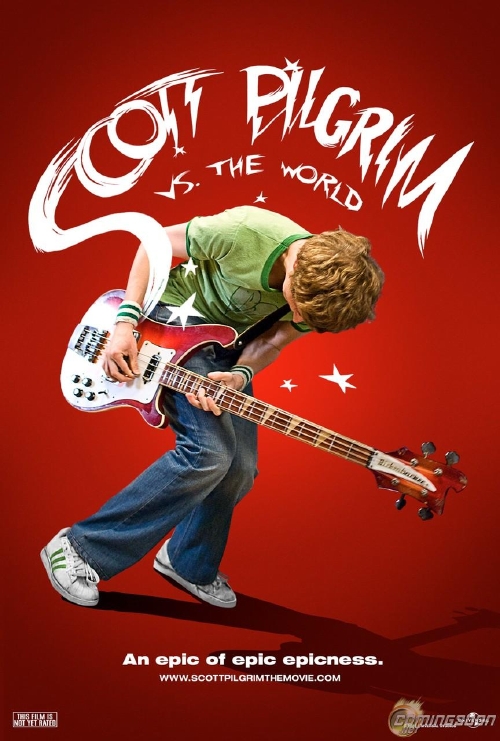
This is the teaser poster, used on products such as OST's as well as promote interest, and shows Pilgrim creating the title from his guitar playing. This reflects the tone of the film due to the amount of visual elements within it, giving it the representation of the graphic novel, as well as the fact one of the plot points is Scott being in a band.
A 3D motion poster was also released, showing Pilgrim playing the guitar in different poses, and like the original poster shows that music is a big part of the film.
The final international poster features, Pilgrim, Ramona and the Evil Exes, and was also used for the cover of the DVD and Blu-Ray. This introduces the idea of Scott, the 'Guitar Hero' symbol gives the audience a clue as to the amount of cultural references in the film, while Ramona's pose adds to her 'mystery'. The logo on this poster better reflects that used in the comics, and so provides a link there

All the posters focus on the character of Scott and his antagonists, without giving away too much of the story.

Film Trailer
This trailer focuses on introducing the idea of the story and league of evil exes, without ruining too much of the story. This is because the series of books is not as well-known as Spiderman or the X-Men, and so an introduction to the narrative would be needed so that viewers would not be confused by the trailer, and put off seeing the film

Magazine cover
 Empire Magazine: #255 (September 2010)
The magazine front cover features Pilgrim using the flaming 'Power Of Love' Sword  (the more well known out of the two featured in the film) he uses in the final fight against Gideon Graves and the red motif which is is the main colour for the marketing campaign. At the top of the page is  an 8-bit Scott head, which is used within the film and other merchandise as a '1-up'. The text makes it look like a comic book cover. Red is used through much of the marketing campaign because it is the colour of love, a major theme in the film. As well this, courage is often associated with the colour red, which is something Scott gains through the course of the film. Cult film lovers may also buy the magazine because of the mention of Shaun of the Dead and Hot Fuzz, due to the connection with the director.
.

Star Wars Episode III: REVENGE OF THE SITH
For the final episode of the new trilogy, all the media was focussed on one event: The turning of Anakin Skywalker and the transformation into Darth Vader. This could explain why the villain is centrepiece on EMPIRE magazine's most popular cover:

The trailer focusses on the journey that turns Anakin, and while it contains spoilers, it isn't a surprise to anyone who has seen the original trilogy before the prequels:
It focusses on the action and Anakin becoming Darth Vader because they are the two things most likely to bring back fans after both the Phantom Menace and Attack of the Clones were not well received by critics and fans, who said the films were too political compared to the original trilogy, and that elements like Jar-Jar Binks made the core audience more for children. Because of this he is given a very small role in the film and is not featured in the trailer at all. Most of the dialogue relates to the war and Anakin's relationship with Chancellor Palpatine, which makes the film look more exciting to those who haven't seen a Star Wars film.

Two posters were created for the UK release of RotS, the first looking like a 'traditional' Star Wars poster
While the second shows Anakin's future as Darth Vader.
Dark and light are major themes in all Star Wars films, not only because of the space setting but also because the stories are about the struggle between good and evil, and the use of darkness could symbolise death winning in the film: the Sith's revenge of the title.
Like the Dark Knight Rise's Lucas used the idea that this would be the last film, or rather 'complete the circle' and so marketing focussed on that element as well as the 'birth' of Darth Vader.
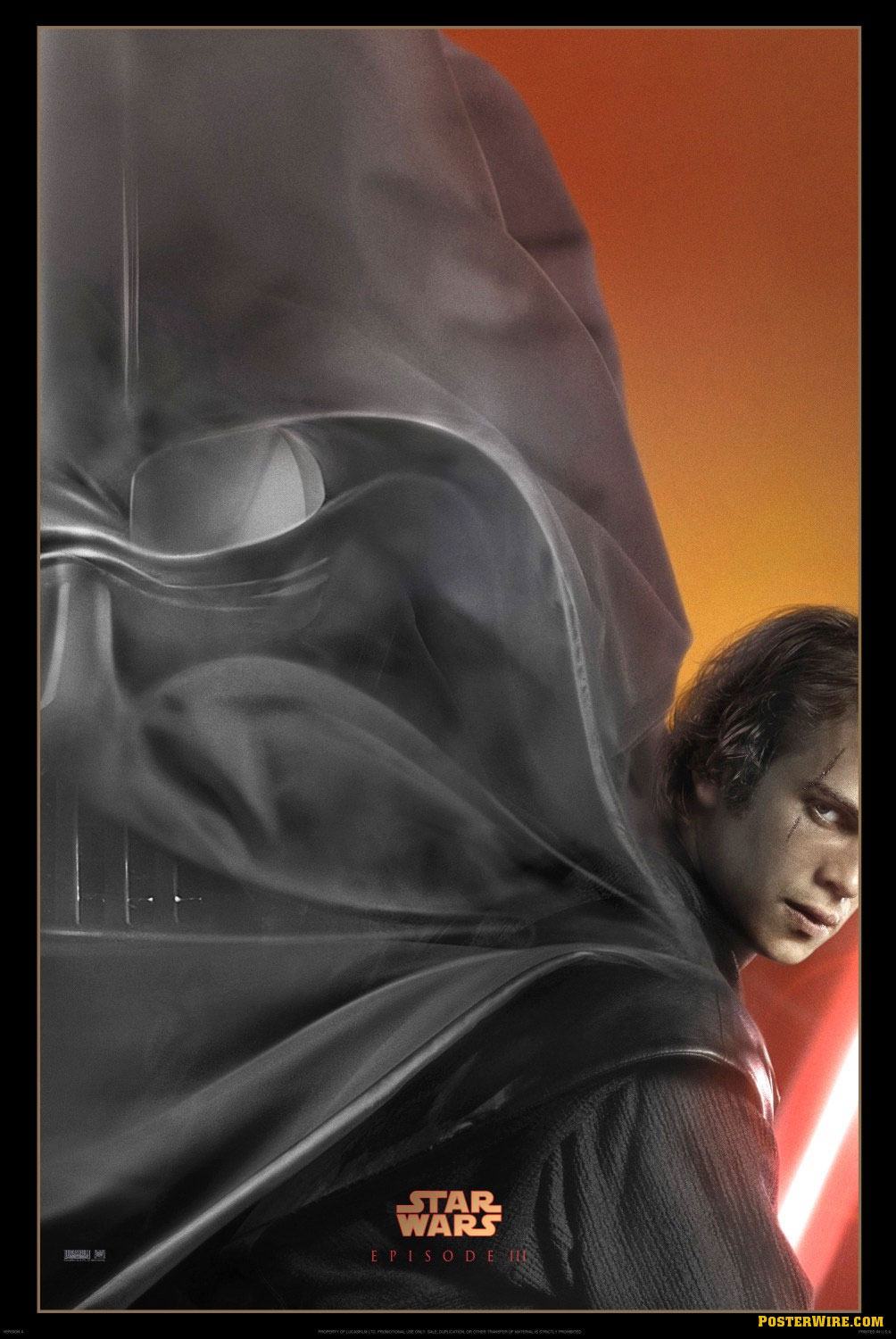
Another character poster focussed on this idea of Anakin turning, with a picture of him moving, and his cape creating the Dath Vader mask. The red lightsaber also would tempt fans, as showing both the character of Anakin with a 'Sith lightsaber' without the suit would show his 'death' and the 'birth' of Darth Vader within the film itself. (Vader is the name given to Anakin when he becomes part of the Sith, the suit was created as Vader received several injuries fighting his former master Obi-Wan on the planet Mustafa, as shown in the theatrical trailer and poster).

Representation of Different groups

Different films represent different types of people in certain ways. For instance, in American Action films, the protagonist is always a military man or bodybuilder, while the antagonist is foreign, normally a country that America has 'defeated' in previous wars, such as the British, Russians and more recently the Middle East. They are normally portrayed as wanting to destroy the 'American way of life' and the hero always wins without so much as a scratch, showing America to be 'invincible'. Sometimes the protagonist stereotype has been challenged successfully. For instance in Rambo the protagonist is a Vietnam veteran who is on the run from American authorities.

Representation is quite different in Thriller films. For instance although women are often used as the protagonist, it is more likely to be a male as the hero, although modern action thrillers such as 'Salt' have used female protagonists. The adaptations of Girl With the Dragon Tattoo make the female protagonist a genius hacker, and do not conform to stereotypes in terms of her personality, looks or sexuality, although this is mainly due to the source material. There is no set representative group in Thriller films as such, as using obvious character archetypes would not build tension in the same way that going against conventions arguably would. An early example of a thriller that does this is Alfred Hitchcock's 'Psycho', which initially makes the audience believe that Marion Crane, a female is the main character, when in fact is the titular Psycho, Norman Bates, who we follow after Crane's death, now an infamous scene. Sometimes a well-established character may be explored in new ways, such as the Guy Ritchie Sherlock Holmes films, or even the Steven Moffat TV series, which places Holmes in a modern setting. These versions of Holmes differ considerably, due to their target audience, and the actors playing them. Steven Moffat's Sherlock, played by Benedict Cumberbatch, is a lot less unfeeling than Robert Downey Jr's portrayal, although Cumberbatch does warm to Martin Freeman's Watson. This could be due to the medium's which they are being broadcasted, the era's (Moffat's Sherlock is modern day, whereas Guy Ritchie's Sherlock Holmes is a typical Victorian London) or even the writers/directors.

Christopher Nolan is a very interesting case study when it comes to character representation. None of his characters are clear cut, and so we are never 100% sure of their motives. For instance, in Memento, his representation of the protagonist with Anterograde amnesia takes a completely different turn at the end of the film, and while the audience may still feel for him, it is for a different reason (he may have already killed the man he is after, and now others are using his condition for their own gain), and the portrayal is considered one of the most realistic of the conditions sufferers (the way the amnesia works, rather than the narrative works). However, this type of plot twist and revelation would not be as hard hitting for the audience if it wasn't for the non-chronological narrative structure, which is perhaps why Nolan does this, and why this film is so critically acclaimed, because we can empathise more with the protagonist. Nolan's portrayal of the Batman universe is also often applauded, and apart from the Joker, everyone has an agenda. Unlike previous incarnations, the characters are dark and realistic, and is more than likely done to stay close to the source material, but also because the previous Batman instalments (Batman Forever, Batman and Robin) were panned, not only because of their poor story-lines, but also because the characters had no depth and were aiming at children. Comparing the Tommy Lee Jones version of Two Face with Aaron Eckhart's, we know what the latter's motivation is, and what turned him from promising attorney, (Gotham's 'White Knight') into a man who depended on luck to make choices, but the former seems like a slapstick pantomime villain with an unrealistic mask. This character progression is seen in both of Nolan's films (apart from the Joker, but this ties in with his portrayal in the graphic novels), and none of the heroes are 100% good (much of Gotham's Police Department are corrupt) and the villains are not always truely evil (Ra's Al Ghul wants to make the world better, and trained Bruce Wayne, but believes humanity is the cause of its pain).

This type of character, flawed heroes and '3-Dimensional' villains (I.E. not the stereotypical Bond villain who only wants to take over the world) are one of the key conventions in most thrillers and so should be an idea seen in my final product.

Saturday, 3 December 2011

Genre Research

One of the most important aspects of marketing a film is knowing the genre of the text and the conventions that go with this. Every genre is different: Comedy, for instance, is a broad genre, but within it the audience expects the film to be funny. Therefore comedy films will do several things to their posters or any magazine covers to show the humour in one image. It might be that the main actors are in a comedic pose (See the poster for Dumb and Dumber, or the The Muppets as examples) or they may use different genre conventions in a different way. For instance, The Waterboy shows the main character in a stadium, like a poster for a sporting drama, but with a bucket in one hand. A Poster for Anchorman: the Legend of Ron Burgundy, meanwhile, is a take on many local American news broadcasters, who would advertise their shows in similar ways.

While the conventions of a Comedy is fairly straightforward, as other genres like Action or Sci-Fi, the conventions o a Thriller film is not so clear. I essence they have to 'thrill' the audience, hence the name, but by definition, surely if a film was 'thrilling' the term would apply to any film that audience member found enjoyable or exciting. But in essence, that is all thriller films do: provide excitement in films through suspense, tension and uncertainty. This is why so many Thriller films will have a plot twist or leave enigma's right until the end of the film.
There are also many sub-genres to the thriller genre. Psychological thrillers are designed to show mind-games and the main theme's relate to the mind. A good example of a psychological thriller is Memento, where a man suffering from a special type of amnesia tries to hunt down the man who gave him his condition and killed his wife. To add to the confusion, the narrative of the film is not chronological, jumping back and forth in almost the same way as the main character's condition is described (he only remembers the last few minutes of his life). Another example of this sub-genre is Shutter Island, which feature's Leonardo Di Caprio as a man hunting down an escaped prisoner in a lunatic asylum. Apart from the overlaying theme of the mind, there is no distinct character type, although in this sub-genre the characters may have an unknown or hidden backstory, which and be struggling with their identity.
Other sub-genres of thriller's include 'Crime Thriller's' which include film's like the Departed, or Zodiac, where either the antagonists identity is unclear, or there is double crossing by either one, or both sides, and techno-thriller's, where technology is one of the main causes for the problems face within the film, such as I, Robot . The characters aren't as clear cut as 'hero' and 'villain' which is the same for most thriller films.
Many directors past and present are renowned for their work in this genre. Almost all of Alfred Hitchcock's films are critically acclaimed thrillers, such as Psycho, the Birds and Rear Window, and more recently Christopher Nolan who made Memento and the updated Batman trilogy.
Essentially, Thriller films will place the protagonist in danger, often their past being hidden or false, and many of the enigma codes aren't revealed until the end of the film. None of the characters are completely good or evil, and there may be a social issue as a subtext.

Monday, 28 November 2011

Linking Texts: Film Marketing and Synergy

All three products created as part of the A2 course must link together effectively. All three products (the Film Trailer, Poster and Magazine Front Cover) need to be related and create 'synergy'. Other forms of Synergy may include novelisations, OST's (Soundtracks), websites, tie-in games, and if it is for a children's film, figurines and models, as well as other memorabillia. Film promotions may also include 'viral marketing', using social media and other techniques to create brand awareness of products such as films.

Examples of this can be found for 'The Simpsons Movie' where '7-11' stores were changed into Resident stores 'Kwik-E-Mart's' and users could 'Simpsonize' themselves online, creating an avatar of themselves (or not) if they were part of the Simpsons. The marketers also held a competition between various 'Springfields' the fictional home of the Simpsons, to hold the premiere. This enabled Fox to keep the film in people's minds, and by having interactive elements to the campaign made the film more of an experience.

The Dark Knight held several viral events, all of which were later posted on a website, with mocked up Gotham newspapers. http://whysoserious.com/ These include, Harvey Dent campaign posters, a rollercoaster at Six Flags, a scavenger hunt at 'Comic-Con' and the reveal of the Joker, where fans emails revealed pixels. The prologue was shown before 'I Am Legend' in IMAX theatres. A similar campaign has started on the sequel 'The Dark Knight Rises' where tweeting #TheFireRises reveals the first image of antagonist Bane. The prologue for this film is scheduled to be released in IMAX before showings of 'Mission Impossible: Ghost Protocol. A manuscript from part of the prologue of the Dark Knight Rises was leaked to film website EMPIRE and technology site Wired.com, with parts cut out, making it look more official and secretive. These elements for both the Dark Knight and its sequel, allow fan's to create a 'hype' surrounding the film.


One of the most extensive examples of synergy in the last few years corresponds to the release of 'Scott Pilgrim Vs the World'. In the months before release there was:
  • The final volume of the source material, Scott Pilgrim's Finest Hour was released by Oni Press.
  • All 6 volumes of the graphic novel were released as digital versions through an iTunes app, costing slightly less and featuring bonus' for completing riddles (tap the screen corresponding to the clue). The film itself is based upon all 6 graphic novels, but uses the second volumes title.
  • 3 soundtracks were released:
    Two scores and an 'Original Motion Picture Soundtrack' which features songs from within the film, many inspiring Bryan Lee O'Malley when writing the graphic novel (Plumtree's Scott Pilgrim for instance) and those sung by Pilgrims band 'Sex Bob-Omb', written by Beck, and one of their rival bands, Crash and the Boys, written by Broken Social Scene. This album also features 8-bit versions of the 'Sex Bob-Omb' song Threshold and Beck singing some of the songs, rather than Sex Bob-Omb. A deluxe version of the album features more Sex Bob-Omb tracks sung by Beck and if downloaded online a video copy of 'The Clash At Demonhead' singing 'Black Sheep' (the album features the original Metric version). Soundtracks are often a popular piece of merchandising and many films will either have an Orchestral score or an original soundtrack, which shows the importance music has to the film
  • A downloadable game by Ubisoft, released on the Playstation Network and later, the X-Box Live Arcade. It is played in the style of an NES brawler (the graphic novel has several hints at retro video games), and features many easter eggs for fans of the comic and the film (The '1-Up' is used in the film and the game, and resembles the comic version of Scott). The game, much like the film, received a positive response and has a 77 on 'Metacritic', a website which rounds up review scores to produce an average. Many reviewers praised the retro feel and called it 'the best film tie in for some time'. When released on DVD and Blu-Ray, an add-on pack was released, which allowed gamers to get more use out of the game. While many video-game adaptations of films add in new villains or events, this is faithful to the original source material and so is similar to the author's original vision.
  • T-shirts, either inspired by what is worn by characters within the film or by illustrations in the graphic novel.
  • An animation produced by Adult Swim, which is the prologue found in the second volume of the graphic novel, and features the voices of the lead actors. This also introduced a 'new' character who isn't in the film, although it could be argued that dropping subplots was a good thing for this film. It also gave the audience who hadn't read the graphic novels more background into Scott's life before the film, which is vaguely touched upon.
  • An EMPIRE magazine cover, which had exclusive behind the scenes access. The magazine later gave the film 5*'s. The cover is covered in more depth in an earlier blog post.
  • Merchandise including key rings, figurines and bags.
  • Around the home release, a box-set of Edgar Wright films was released on DVD and Blu-Ray, including Shaun of the Dead, Hot Fuzz and Scott Pilgrim. Many of the extra's on the three are quite similar, from a 'trivia track' to 'edited TV scenes' where the swearing is replaced by less offensive words. Shaun of the Dead's 'Funky Pete' version has since become a viral video.

Sunday, 27 November 2011

Film Trailer Research

The main product within my A2 coursework is a trailer, and so researching the conventions of trailers is something that I must do early on in the planning stages. I looked at several different film trailers for this research task. There are two main types of trailer: teaser and theatrical, of different lengths and which show different amounts of film. Teasers are shown during the films production in order to create awareness of the film, while Theatrical trailers are shown a couple months pre-release, where the film has been completed. A third trailer type is a 'TV Spot' which is normally around 30 seconds and shown around the time of the films theatrical run.

Firstly V For Vendetta, a dystopian Sci-Fi based on Alan Moore's graphic novel of the same name. It opens with flashes of images, mainly Natalie Portman's character Evie being captured and interrogated. After the brief conversation, it cuts to the studio logos before showing the dystopian society, where we get a narration by V. We see title graphics 'An uncompromising vision of the future' followed by 'from the directors of "The Matrix trilogy"'. We see acts of rebellion, and then the V symbol, while the title character says the famous rhyme 'remember, remember the fifth of November'.

From the opening shots of Evie being interrogated by an unseen man in the shadows, with a voice-over showing some of her 'crimes' we can see this isn't going to be an action film, and the Dystopia is akin to 1984. It also sets up the enigma of V's identity, as we only see a quick flash of him to begin with, and so this creates an air of mystery about him. Much of the shots hide his mask in the shadows (we never learn of his true identity). Once we see V fully however, the quick cuts featuring hand to hand combat and explosions show that as well as ideas and subtext, the film will also contain a lot of action. This will mean viewers who may not like a plot heavy film (for instance the Transformers series) would go and see this.
It also gives some background into the events that took place, with the bio-weaponry scene, and one image in particular is almost identical to one found in the film version of 1984, where the leader of the new UK is talking to thousands of people on TV, which is similar to the Big Brother speeches. This means that the films themes and tone should be instantly recognisable, as does the familiar London setting, which, if this is a UK trailer, means brings the ideals closer to home. Natalie Portman is selling this film, as she is the only actress named, and features prominently. This may be because the identity of V is a secret within the film, and so is in keeping with the character. The slow motion knives intercut between action shots at the end illustrate that it will be similar to the Wachowski's previous film the Matrix (mentioned as a title card) and V's monologue emphasises the mix between action and subtext. The fans of the graphic novel would see this, as well as those who like Thriller films, or even the Matrix films.

Another trailer I looked at was The Girl With The Dragon Tattoo. There are two distinct trailers for this, the first is a teaser, which features a version of Led Zeppelin's 'Immigrant Song' over a montage of images. The theatrical trailer, gives more of the story, and introduces the protagonists, Lisbeth and Mikael, as well as the plot, where Mikael has to write find a girls killer.
By using quick cut images which fans of the book will recognise, as well as key characters, it means that they will see similarities with the source text. The style of the lettering and the fact it was marketed as a 'feel bad' movie gives us an idea that the film is very serious in tone and that Lisbeth is more of an anti-hero. The version of 'Immigrant Song' is used because of Lisbeth's character, especially her portrayal in this version. The lack of dialogue but mention of source material may intrigue those who have yet to read the book. As well as this, Daniel Craig is featured extensively, possibly to entice Bond fan's to watch, although the themes are more like some of his art-house work. Both this and the full theatrical trailer give plot details, although this works as showing it is an adaptation of the books, rather than an original story, so giving away certain plot details (but not the main villain) works to it's advantage in this way. The original Swedish versions are considered one of the most popular foreign language films because of it's connection with the books, and so these trailers show that this version is like the source text but different from the original film adaptation. Because it has source material, the audience will mainly consist of fans of the original book but also of people who have not read the books but know how acclaimed they are.

Donnie Darko is a cult Sci-Fi film, for which a trailer was created for the Directors Cut release. After some title cards and a tagline, a mystery voice says wake up, to which we see an eye opening, followed by some symbols. The rest of the trailer is a montage of images from the film, with actors credits. The director credit appears over a shot of Donnie, before flashing up the film title, where we cut to a shot of 'Frank' and 'Are You Ready?'
By doing this, it creates intrigue, as not many of the actors were well known at this point, and the biggest name would have been Patrick Swayze, and so the audience would go to see in order to understand the trailer. However, the plot can be seen as confusing, which may put potential audiences off, especially as it is an original rather than adapted story. However, not giving away too much of the trailer works for thriller films like this, especially as this film is not considered a blockbuster, and so by showing that it is an 'Indie' film with some big plot ideas be attract some audiences

The Woman in Black is an upcoming Horror by Hammer Films. The trailer consists of a wide shot of Arthur Kipps standing at a train station, followed by the studio logos,. We then see a woman telling Kipps not to go to Eel Marsh House, before clips of him travelling and arriving there. A man talks about 'opening the door to superstition' where it cuts to Kipps opening the front door, where the three monkeys 'Hear No Evil, See No Evil, Speak No Evil' are seen on a mantle. We then see Kipps in a Victorian childs room, looking at some photos, and seeing the effects of 'the woman'. Text appears on a misty window 'The Door has Opened', before seeing a montage of clips. The point of this 'teaser' is to build tension for the audience and to create awareness of the film. It would attract horror fans, particularly those of the original Hammer company, as well as those who have seen the successful West End Show, possibly to see the similarities. Daniel Radcliffe is used throughout as a marketing tool, as he is a recognisable face in British cinema, having played Harry Potter for 8 films. This is his first major role outside the franchise, and so people would want to see his acting credentials in a different role.